Quick answer: Threat assessment business marketing works best buyer by buyer. School districts want standards, training and a calm tone. HR leaders want a confidential, fast way to get help with a specific person. Attorneys want credentials and defensible methods. Build a page and a message for each, make a confidential consultation easy to request, and prove expertise without sounding alarming.
Threat assessment business marketing is awkward for a simple reason: nobody wants to need you. The people who hire a threat assessment firm are usually worried about a real person, a real behavior or a real liability. They aren’t browsing. They’re anxious, short on time and checking whether you look calm, credible and discreet.
So the usual small business marketing playbook (bright offers, urgency, “book now”) backfires. This guide lays out what does work, buyer by buyer, using the site we built for Risk Mitigation Technologies, a behavioral risk and threat assessment consultancy, as the running example.
Key takeaways
- Market to three different buyers: schools, HR and executives, and legal counsel. Each one decides differently.
- Calm beats dramatic. Alarming imagery and fear based copy push cautious buyers away.
- A confidential consultation should be one click away on every page.
- A named method (a framework, a process) turns invisible expertise into something buyers can remember and repeat.
Why threat assessment business marketing is different
Most service marketing tries to create demand. Threat assessment marketing mostly has to be there when demand appears, and to look trustworthy in the minute someone checks you out.
A few things make it unusual. The purchase is sensitive, so visitors won’t fill out a long form or chat with a bot. The buyer often isn’t the person with the problem (an HR director is calling about an employee, a principal about a student). And the decision has to be defensible later, sometimes in front of a board or a court. Every page you publish should help that buyer explain, afterwards, why they chose you.
Buyer one: school districts and campuses
Schools are the most visible threat assessment market. The U.S. Secret Service National Threat Assessment Center describes behavioral threat assessment in K 12 schools as a proactive process carried out by multidisciplinary school staff, one that focuses on behavior in context and isn’t a disciplinary or criminal process. That framing matters for your marketing. Districts want help building and training a team, not someone who swoops in.
What school buyers look for online:
- Team training and program setup, described in plain language a superintendent can forward to a board.
- Alignment with recognized guidance and standards, named specifically.
- Experience in education, not only law enforcement or corporate security.
- A hopeful tone. We made this the core of the Stone Campus Safety website: teal and white, bright campus imagery and no threat focused visuals, because dark, fear driven sites put education leaders off.
Buyer two: HR leaders and executives
HR is often the first call when an employee’s behavior raises concern. There’s a legal backdrop too. OSHA has no specific workplace violence standard, but it enforces workplace violence under the General Duty Clause, and it treats an employer that has seen violence, threats or intimidation as on notice of the risk. HR leaders know this, and they want someone who can help them act quickly and document it properly.
What HR and executive buyers need to see:
- A clear statement that you handle specific, live concerns, not just policy reviews.
- Speed: how fast you respond and what the first conversation covers.
- Confidentiality, stated plainly and backed by a private contact path.
- Training and prevention programs for after the immediate issue is handled.
Buyer three: general counsel and outside attorneys
Lawyers buy differently. They’re checking whether your methods will hold up and whether your credentials will survive scrutiny. They read your about page closely and they notice vague claims.
- Credentials, training and professional memberships, listed precisely.
- Your methodology, named and explained.
- Publications, talks and media, with dates.
- Expert witness or consulting expert experience, on its own page if you offer it. Our guide to expert witness website design covers what attorneys look for.
Worked example: Risk Mitigation Technologies
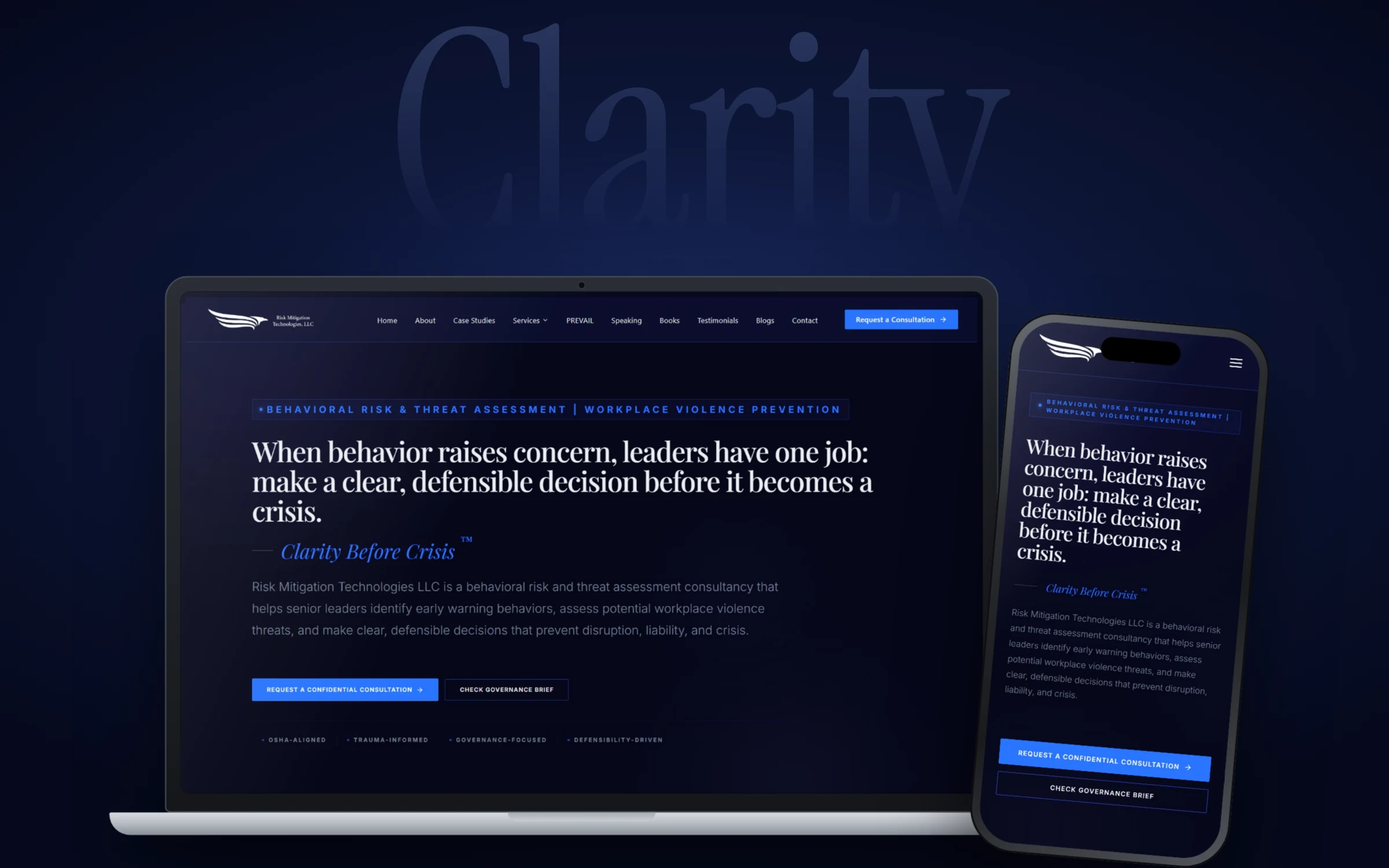
Risk Mitigation Technologies, founded by Joseph Paul Manley, helps senior leaders recognize early warning behaviors, assess potential workplace violence threats and make defensible decisions. Its visitors are CEOs, HR leaders, general counsel and boards. Its clients include leadership teams, HR departments, legal counsel, healthcare organizations, education institutions and corporate security groups.
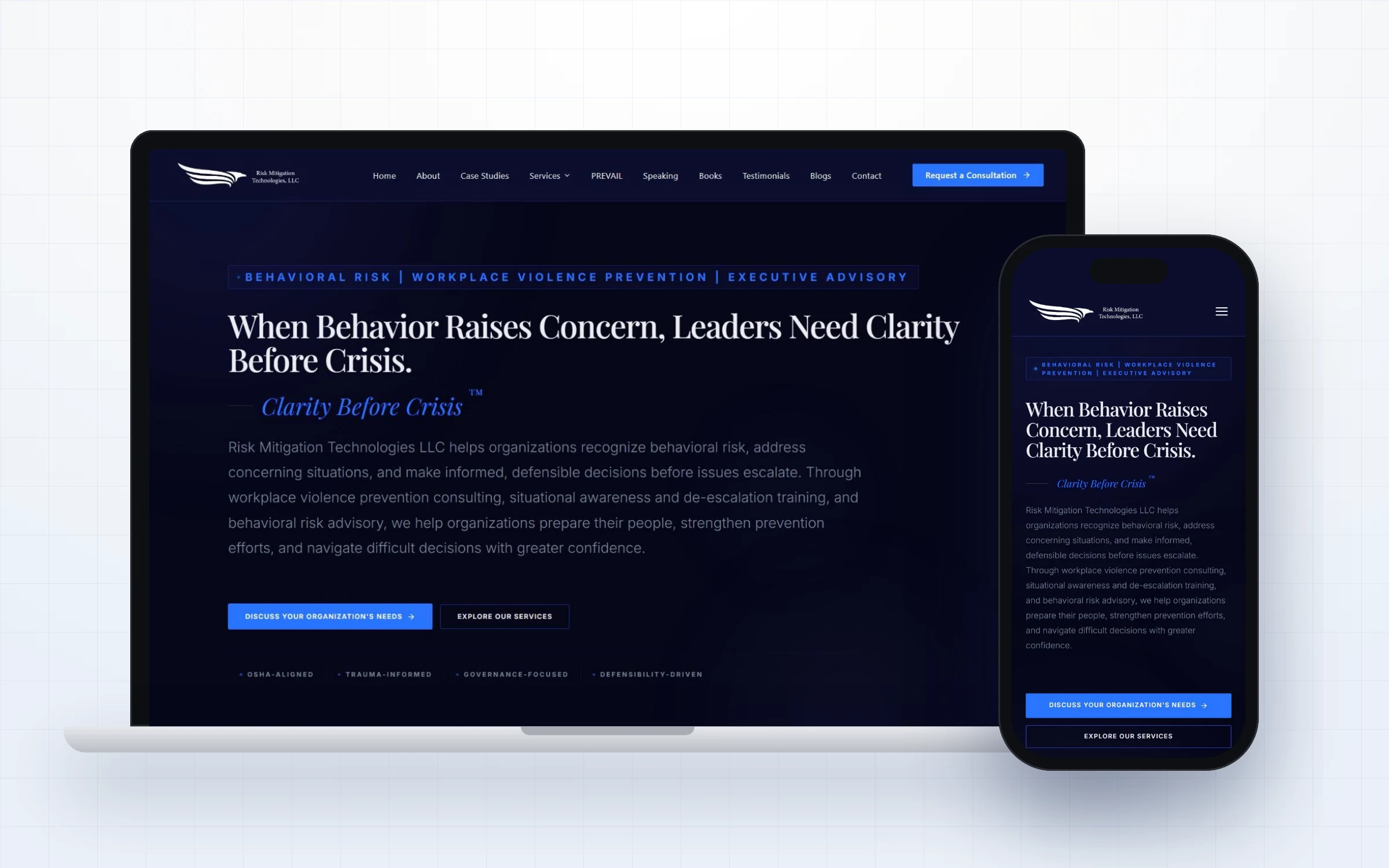
The old online presence spread its message thin, used a generic visual tone and had no single obvious next step. Here’s what we changed:
- Lead with the decision. The headline speaks to a leader who has to make a clear, defensible decision when behavior raises concern, instead of listing services.
- One action everywhere. “Request a Confidential Consultation” sits in the header, the hero and at every key decision point.
- Calm, editorial design. Deep navy with one bright blue accent, a refined serif headline, real founder photography and no alarming stock images.
- Turn the method into a brand. The firm’s PREVAIL framework got its own page, presented as a leadership system people can remember and repeat to colleagues.
- Proof before doubt. Media logos, founder credentials and testimonials appear near the top, where questions start.
- Room to grow. A custom Elementor widget library so the team can add speaking topics, case studies and resources without breaking the design.
Joseph’s journey started on LinkedIn, which is typical. Many threat assessment professionals build trust there first, so the website and the LinkedIn profile have to tell the same story. We covered that side in the LinkedIn branding work for Risk Mitigation Technologies.
How to market a threat assessment company step by step
Here’s the order we’d tackle it in for a firm starting from a thin website and a LinkedIn profile.
- 01
Pick your primary buyer
Schools, HR and executives, or legal. You can serve all three, but your homepage should lead with one.
- 02
Name your method
Give your process a name and a few clear stages. It makes your expertise visible and easy to repeat.
- 03
Build one page per buyer
A schools page, a workplace page and an attorneys page, each written in that buyer's language.
- 04
Make the private path obvious
A short confidential consultation form plus a direct phone number. No chatbots, no long intake forms.
- 05
Publish calm, useful content
Articles on warning behaviors, team setup and documentation. Helpful, never sensational.
- 06
Align LinkedIn with the site
Same headline, same method, same call to action, so referrals see one consistent firm.
Content and SEO for threat assessment firms
Search volume for threat assessment terms is small, and that’s fine. A handful of the right visitors a month (a district safety director, an HR vice president, a law firm associate) is worth more than thousands of students researching a term paper.
Focus on searches with a buyer behind them: “workplace violence threat assessment consultant,” “behavioral threat assessment training for schools,” “threat assessment expert witness.” Give each its own page. Then support those pages with articles that answer the questions buyers ask on calls. Our SEO for consultants guide explains the basics, and the guide to starting a security consulting business covers positioning if you’re newer to running a firm.
Frequently asked questions
How do threat assessment firms get clients?
Mostly through referrals, professional networks, speaking and LinkedIn, with search bringing in buyers who are actively looking. The website is where all of those buyers check you before they call.
Should a threat assessment website show case studies?
Only anonymized ones, and only with permission. Describe the situation type, the process and the outcome without identifying details. Many firms rely on credentials, methodology and testimonials instead.
What tone should threat assessment marketing use?
Calm, plain and confident. Fear based headlines and dark imagery make cautious buyers uneasy. Show that you bring clarity to a stressful moment.
Do I need separate pages for schools and businesses?
Yes, if you serve both. School leaders and HR directors use different language, face different rules and ask different questions on the first call.
Is LinkedIn worth it for a threat assessment consultant?
Usually yes. Decision makers check LinkedIn before they reply to an introduction. A clear banner, headline and Featured section that match your website make that check easy.
How quickly can a threat assessment firm get a new website?
Our consultant sites typically follow a four week plan from discovery to launch, starting with a free homepage concept. Content and feedback speed are the main variables.
Be the calm name they call first
Good threat assessment business marketing doesn’t shout. It makes the right buyer feel, within a minute, that you understand their situation, that your method is sound and that reaching you is private and easy.
If you’d like help building that, see our website design for security consultants and get in touch. We’ll start with a free homepage concept so you can judge the direction before committing.