
Quick answer: SEO for security companies starts with a keyword map by buyer and service: one page for each service (assessments, guarding, executive protection, expert witness), location pages only where you really work, and a Google Business Profile that matches. Then publish content that proves judgment without revealing tactics, and measure inquiries, not rankings.
Most advice on SEO for security companies is written for alarm installers and guard firms chasing “security company near me.” That’s one kind of security business. If you’re a physical security consultant, a guarding company bidding on contracts or an executive protection firm, your buyers search differently, and your content has an extra constraint: you can’t publish your playbook.
This guide is the version we use with security clients. It covers how to map keywords by buyer, which pages to build first, how local search fits, what content to publish when discretion matters, and how to tell if any of it is working.
Key takeaways
- Map keywords to buyers first. A facilities director, a school superintendent and an attorney search for different things.
- One page per service beats one long services page. It is the single biggest structural fix for most security sites.
- Location pages only help where you really operate and can say something specific.
- Publish judgment and process, never vulnerabilities or protective methods.
How security buyers actually search
Security purchases are rarely impulse buys. A facilities manager looking for a vulnerability assessment, a church leadership team worried about safety, an HR director dealing with a threatening employee and a law firm needing a security expert witness all start on Google, but with different words and different levels of urgency.
Roughly, security searches fall into four groups:
| Buyer | Typical searches | Page they need |
|---|---|---|
| Facilities and corporate security | physical security assessment, access control consultant, security risk assessment for offices | Service page per assessment type |
| Schools and houses of worship | school security assessment, church security consultant, house of worship safety plan | Sector page written in that buyer’s language |
| Legal | security expert witness, premises liability security expert | Expert witness page with credentials and case types |
| Local and urgent | security guard company [city], event security [city], executive protection [city] | Service plus location page, Google Business Profile |
If your site has one “Services” page listing all of these in bullets, it can’t rank well for any of them. That’s the first thing we fix.
Build the keyword map for SEO for security companies
Here’s how we build it. Start with every service you actually sell and want more of. For each one, write down who buys it and the two or three phrases they’d type. Check those phrases in Google: if the results are other consultants’ service pages, it’s a buyer search. If they’re Wikipedia and government PDFs, it’s research, and better suited to an article.
Then assign one primary phrase to one page. No two pages should chase the same phrase. A typical map for a security consulting firm looks like this:
- Vulnerability assessments (service page)
- Physical security and access control (service page)
- School safety consulting (sector page)
- House of worship risk assessment (sector page)
- Security expert witness (dedicated page)
- About, with full credentials (supports every page above)
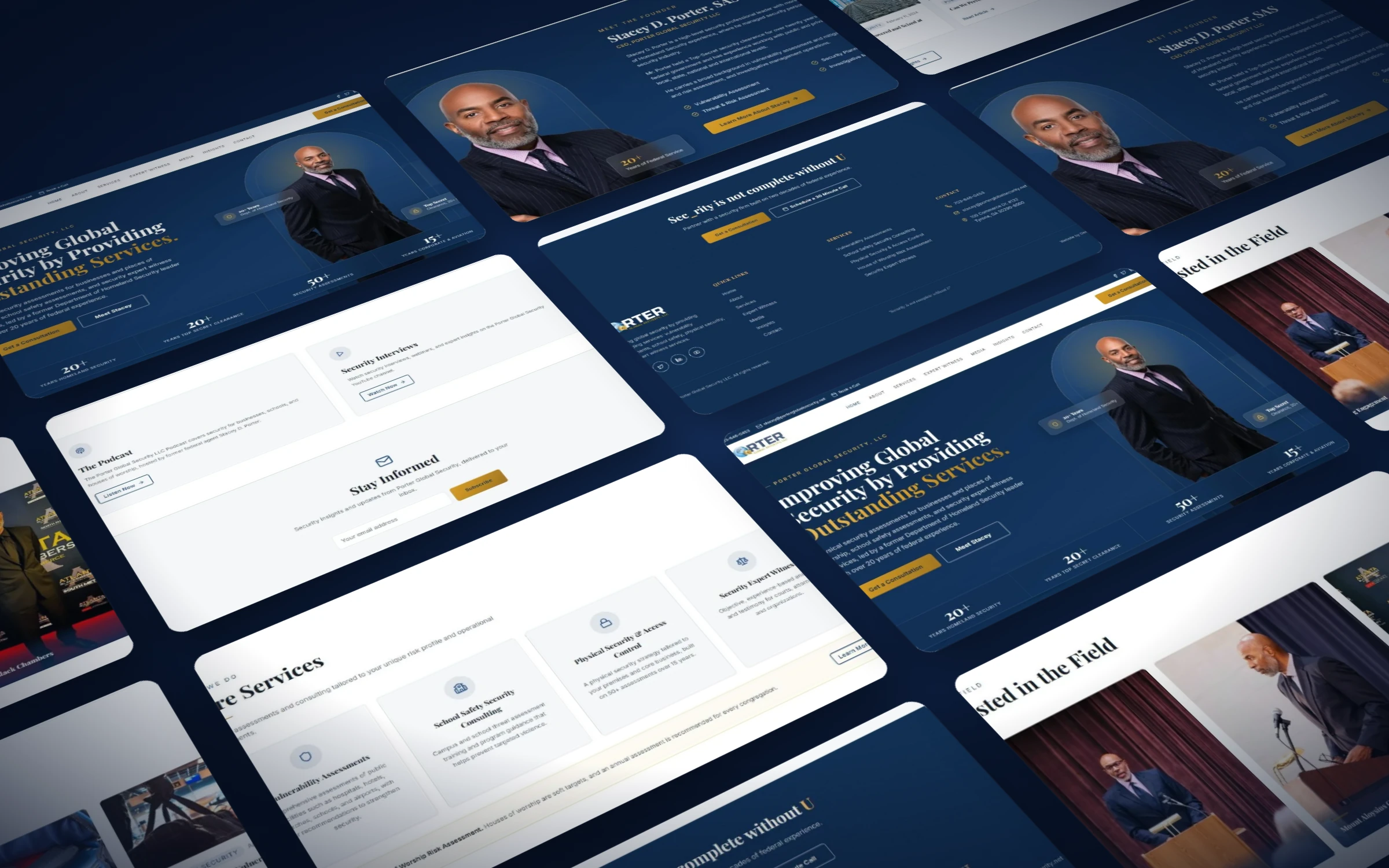
That list isn’t hypothetical. It’s close to the structure of the Porter Global Security website we redesigned for Stacey D. Porter, which has separate pages for vulnerability assessments, school safety consulting, physical security and access control, house of worship assessments and expert witness work.
Security company SEO for local and multi location firms
If you sell guarding, patrol, event security or executive protection in specific cities, local search matters most. Google says local results are based mainly on relevance, distance and prominence. Translation: a complete Google Business Profile with the right categories and services, an address or service area that’s honest, and reviews and mentions that show you’re known.
Location pages are where security firms waste the most effort. Twenty near identical pages that swap the city name don’t help, and they make the site look thin. Build a location page only where you have real work, staff or clients, and fill it with specifics: sites you cover, local regulations you deal with, response times, the type of clients you serve there.
Consultants who work nationally can skip most of this. Your Google Business Profile still matters for brand searches, but your growth comes from service pages and content. Our local SEO guide covers the profile setup step by step.
Content that proves expertise without giving away tactics
Security is one of the few fields where the usual “teach everything” content advice is dangerous. You shouldn’t publish a client’s weak points, a protective detail’s methods or a step by step guide to defeating access control.
What you can publish, and what buyers actually want to read:
- How you think. What you look at first on a site walk, and why. The questions you ask leadership before an assessment.
- What buyers get wrong. Common gaps in emergency plans, the difference between a policy and a practiced plan.
- Process explainers. What happens during an assessment, how long it takes, what the report includes.
- Anonymized lessons. “A mid sized church we worked with” with no identifying details and the client’s permission.
- Commentary. Your take on incidents or new guidance, published quickly and calmly.
This kind of writing does two jobs. It ranks for research searches, and it gets quoted by AI search tools that answer buyer questions. Our guide to AI search optimization explains how to format it so it gets cited.
Technical basics and trust signals
Security buyers judge trust fast, and so does Google. Cover these:
- Credentials, licenses, memberships and insurance written as text, not only as logo images, so search engines and AI tools can read them.
- A fast, mobile friendly site with HTTPS. Many buyers check you on a phone between meetings.
- Organization or LocalBusiness schema with your correct name, address and phone. Don’t add review stars about yourself, though. Google says pages where a business controls reviews about itself are ineligible for star review features.
- Unique titles and meta descriptions on every page, and one clear H1.
- Search Console and analytics connected, with form submissions and calls tracked as conversions.
Our technical SEO checklist goes through the rest.
SEO for security companies: a 90 day plan
If you’re starting from a basic site, this order gets the most done first.
- 01
Map buyers, services and phrases
One primary phrase per page, based on what your buyers type and what already ranks.
- 02
Split services into separate pages
Each with a clear headline, who it is for, what is included and a consultation button.
- 03
Fix the trust basics
Credentials in text, an about page that names your experience, schema, titles and Search Console.
- 04
Complete your Google Business Profile
Categories, services, service area, photos and a steady stream of honest client reviews.
- 05
Publish two useful articles a month
Process and judgment pieces that link to the relevant service page.
- 06
Track inquiries by page
Which pages produce calls and forms. Double down on those, rework the rest.
How long does SEO take for a security company?
For a small firm with a decent site, expect early movement on service pages within a few months and steady gains over six to twelve. Competitive local guarding markets take longer. Narrow consulting niches (house of worship assessments, security expert witness work) often move faster because fewer firms target them properly. Our honest breakdown is in how long does SEO take.
Frequently asked questions
What is the most important SEO step for a security company?
Giving each service its own page. Most security sites list every service on one page, which makes it hard to rank for any of them.
Do security consultants need local SEO?
Less than guard firms do. If you work nationally, focus on service pages and content. Keep a complete Google Business Profile for brand searches and reviews.
Should a security company blog?
Yes, if the posts show your judgment and process. Avoid publishing anything that reveals client weaknesses or protective methods.
Is SEO for cybersecurity companies different?
Yes. Cybersecurity buyers are often technical and search for specific products, frameworks and compliance terms. The structure advice here still applies, but the keyword research and content look very different.
Can I add review stars to my security company website?
You can show testimonials, but Google treats reviews a business controls about itself as ineligible for star features in search results. Focus on Google Business Profile reviews instead.
Should I hire an SEO agency that knows the security industry?
It helps. An agency that understands security buyers will write for superintendents, facilities directors and attorneys instead of generic home security shoppers.
Rank for the searches that turn into contracts
Good SEO for security companies means being the clear, credible answer for the handful of searches your best buyers type, with a page built for each. Chasing every security keyword just spreads you thin.
If you want help with that, see our SEO services and our work in website design for security consultants, or read what buyers look for on a security consultant website. When you’re ready, contact us for a free review.