Quick answer: A strong executive bio opens with your current role and the problem you solve, backs it with two or three specific proof points, shows the career path that earned you that authority, and ends with something human. Keep a 50 word short version and a 200 to 300 word long version, mostly in third person, and adapt each for where it will appear.
An executive bio gets read in strange places. A conference host reads it aloud while you stand at the side of the stage. A procurement officer skims it on page 14 of your proposal. A board chair opens your LinkedIn profile on a phone between meetings. Same person, very different moments, and one bio rarely fits them all.
This guide shows how to write an executive or consultant bio in two core lengths, when to use first or third person, and where each version belongs. You’ll get fill in templates and four short example bios I wrote for invented people, so you can see the structure working before you write yours.
Some context on why I care about this: at Design Fly 24 we build websites and LinkedIn profiles for consultants, expert witnesses and senior advisors, and the bio is almost always the piece clients have put off. It’s also the piece buyers read most closely.
Key takeaways
- Lead with what you do now and who you do it for. Career history comes second.
- Write two master versions (short and long) and adapt them, rather than one bio for everything.
- Third person works for speaker intros, proposals and most About pages. First person fits LinkedIn.
- Specific facts beat adjectives. “Led security for 14 hospitals” beats “seasoned security leader.”
What an executive bio needs to do
A bio has one job: make the reader trust you enough to take the next step. That might be booking a call, approving your proposal or listening closely to your talk.
So it needs to answer, quickly, the questions a stranger has about you:
- What do you do now, and for whom?
- Why should I believe you’re good at it?
- How did you get here?
- Who are you as a person?
Most weak bios answer only the third question. They start in 1998 and march forward one job at a time, so the reader has to do the work of figuring out why it matters. Flip that. Start with today, then use history as evidence.
How to write an executive bio, step by step
This is the order I use when I draft a bio with a client. It takes about an hour if you have your CV and LinkedIn profile open.
- 01
Pick the reader
Decide who reads this version: a buyer, an event audience, an attorney, a board. The same facts get ordered differently for each.
- 02
Write the opening line
Name, current role and the problem you solve, in one sentence. If someone read only this line, they should know whether to keep reading.
- 03
Choose two or three proof points
Pull the most specific facts you have: years in a role, scale of teams or budgets, named institutions, publications, credentials. Only use numbers you can back up.
- 04
Add the career arc
Summarize the path in one or two sentences, focusing on the moves that explain your expertise rather than every title.
- 05
Add one human detail
A sentence about where you live, what you do outside work or why you care about the field. Keep it short and true.
- 06
Close with a next step
On a website or LinkedIn, tell the reader how to reach you. In a speaker intro, end on a line the host can say with energy.
- 07
Cut it in half, then check it
Remove adjectives that a fact already proves. Read it aloud, and check every claim against your CV and LinkedIn so they match.
Short and long versions: how long should an executive bio be?
Write two master versions and you’ll cover almost every request you get.
| Version | Length | Where it goes |
|---|---|---|
| One liner | One sentence | Email signature, podcast guest list, LinkedIn headline |
| Short bio | About 50 to 100 words | Speaker intros, event programs, proposal team pages, author boxes |
| Long bio | About 200 to 400 words | Website About page, media kit, board and award submissions |
Those ranges are close to what other guides recommend too. River’s executive bio guide, for example, suggests 50 to 75 words for a short version and 250 to 400 for a long one. Event organizers often send their own limit, so always check before you paste.
One tip that saves time later: write the long version first. Cutting down is much easier than padding up, and the short bio usually turns out to be the long bio’s first paragraph with a tighter ending.
First person or third person?
This is the question I get most, and the answer depends on who’s speaking.
Use third person (“Maria advises hospital boards…”) when someone else is presenting you: a speaker intro, a proposal, a press kit, a firm’s team page, or a conference program. It reads as more objective, and the host can say it without editing.
Use first person (“I help hospital boards…”) when you’re speaking directly to the reader. LinkedIn is the main one. A first person About section sounds like a person, and third person on your own profile tends to read as if an assistant wrote it.
Your website About page can go either way. Solo consultants often do well with a third person bio up top and a short first person note below it, such as why they started the practice. We go deeper on that page in our guide on how to write an About page that makes clients want to call.
Whatever you pick, don’t switch midway through the same bio. That’s the most common slip I see.
Executive bio template you can fill in
Copy these, replace the brackets and then rewrite anything that sounds stiff. The template is a scaffold. Your voice is the finish.
Short bio template (third person)
[Name] is [role] at [firm], where [he/she/they] helps [type of client] [solve specific problem]. [He/She/They] brings [number] years of experience in [field], including [most impressive proof point]. [Credential or affiliation]. [He/She/They] is based in [city].
Long bio template (third person)
Paragraph 1, the present: [Name] is [role] at [firm]. [He/She/They] works with [clients] on [problems], with a focus on [specialty].
Paragraph 2, the proof: Before founding [firm], [Name] spent [years] at [organization], where [he/she/they] [specific responsibility or result]. [Second proof point]. [Credential, publication or recognition].
Paragraph 3, the approach: [One or two sentences on how they work or what they believe about the field.]
Paragraph 4, the person: [Education if relevant]. [A short personal detail]. [How to reach them.]
Consultant bio examples (written for this guide)
These consultant bio examples are ones I wrote for invented people, so you can see the templates in action. The details are fictional. Don’t copy the facts; copy the order.
Example 1: short bio, emergency management consultant, third person
[Name] helps county governments and hospital systems plan for the disasters they hope never come. A former deputy fire chief with 24 years of service, [he] has written emergency operations plans for more than 40 public agencies and teaches incident command courses at a regional fire academy. [He] is based in Denver.
Example 2: short bio, finance advisor, written for a speaker intro
Our next speaker spent 20 years as a CFO, first at a regional grocery chain and then at a software company that grew from 60 to 400 employees on her watch. Today she works as a fractional CFO for founder led companies that have outgrown their spreadsheets but aren’t ready for a full time finance chief. Please welcome [Name].
Example 3: LinkedIn About opening, supply chain consultant, first person
I help midsize food and beverage brands fix the supply chain problems that show up as empty shelves and angry retailers. I spent 16 years running distribution and procurement for two national brands before going independent in 2019. Most of my clients call me after a bad quarter. If that’s where you are, send me a message here and tell me what broke.
Example 4: long bio, leadership consultant, third person
[Name] is a leadership consultant who works with family owned manufacturers during the hardest moment in their history: handing the business to the next generation.
Before starting her practice in 2016, she spent 15 years in operations leadership at two midsize manufacturers, the last six as chief operating officer. She has guided more than 30 succession transitions and teaches a graduate course on family enterprise at a state university.
Her approach starts on the shop floor, not in the boardroom. She interviews people at every level before recommending anything, because she believes succession plans fail when the people doing the work weren’t asked.
She holds an MBA and lives in Ohio, where she coaches youth soccer badly and enthusiastically. You can reach her through her website.
Notice what these share. Each opens with the client and the problem. Each uses numbers that a reader could, in principle, check. None of them says “passionate,” “results driven” or “thought leader.”
Where each version of your bio is used
Website About page
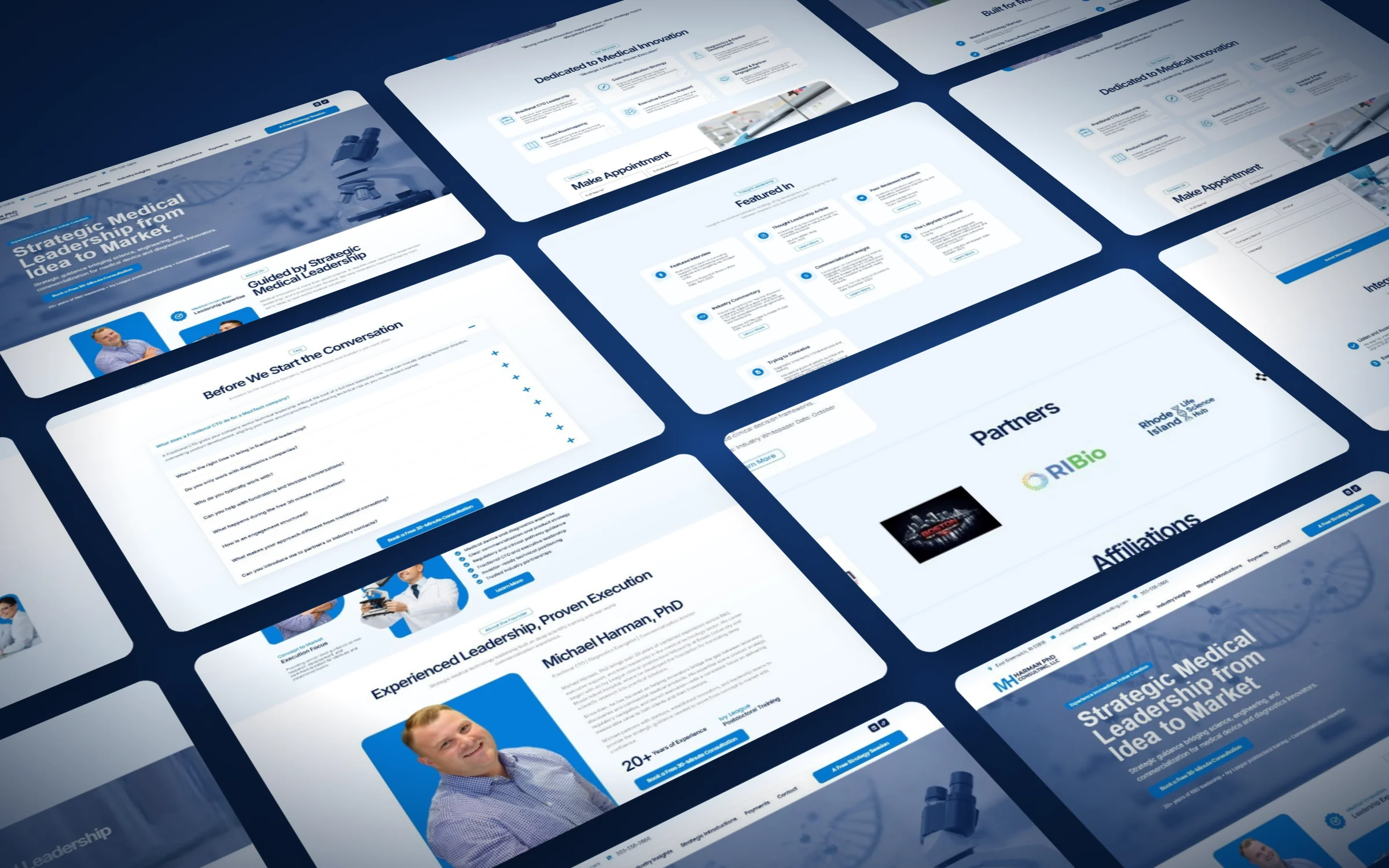
Your long bio lives here, with a real photo. On a solo consultant’s site, the founder bio often does more selling than the services page. When we redesigned the site for Harman PhD Consulting, Michael Harman’s credentials sit directly under the first call to action, and the homepage has its own About the Founder section. For Stone Campus Safety, Dr. Sherry Colgan Stone’s career story became an “Our Story” section, because her path into campus safety is part of why clients trust her.

LinkedIn About section
Use a first person version here, and front load it. LinkedIn allows 2,600 characters in the About section, but only about the first 300 show before “See more”, so your first two lines carry the weight. Our LinkedIn profile tips for consultants and LinkedIn About section examples cover the rest of the profile.
Speaker introductions
Send the short bio in third person, written to be read aloud. Avoid long lists of acronyms and parentheses; hosts stumble on them. End on your name or a line that sets up your talk. If you speak often, keep this version on your speaker website so organizers can grab it themselves.
Proposals and team pages
In a proposal, tailor the short bio to the project. If the bid is for a school district, lead with your school work, even if it’s a smaller share of your practice. Buyers scan team bios looking for “has this person done exactly what we need?”
Mistakes that make a bio forgettable
- Starting with your first job. Lead with today.
- Adjectives instead of evidence. “Dynamic, strategic, visionary” tells the reader nothing. One concrete number does more.
- Listing every credential. Choose the ones your reader recognizes. A long string of letters after your name is a wall, not a welcome.
- Different facts in different places. If your website says 20 years and LinkedIn says 18, someone will notice. For expert witnesses, opposing counsel definitely will.
- No photo, or an old one. A bio with a current, professional photo gets read. See our professional headshot tips.
Your bio is one piece of a bigger picture. If you’re working on how people see you overall, our guide to personal branding for consultants connects the bio to your headline, photo, website and content.
Frequently asked questions
How long should an executive bio be?
Keep a short version of about 50 to 100 words for speaker intros and proposals, and a long version of about 200 to 400 words for your website and media kit. Always check any limit an event organizer gives you.
Should an executive bio be in first or third person?
Use third person when someone else presents you, such as speaker intros, proposals and press kits. Use first person on LinkedIn, where you speak directly to the reader. Pick one per bio and stick with it.
What is the difference between a consultant bio and an executive bio?
An executive bio often describes a role inside one organization. A consultant bio has to sell, so it leads with the clients you help and the problem you solve, then uses your history as proof.
What should I include in a professional bio?
Your current role, who you help and how, two or three specific proof points, a short career summary, relevant credentials, one personal detail and a way to reach you.
Can I use the same bio on LinkedIn and my website?
Use the same facts, but adapt the voice. A first person version fits LinkedIn, while your website usually works better with third person plus a short personal note.
How often should I update my bio?
Review it every six months and after any new role, credential, book or major client. Update your website, LinkedIn and speaker materials at the same time so they match.
Make your bio work as hard as your experience
The best executive bios aren’t clever. They’re clear. Who you help, why you’re credible, how you got here and one detail that makes you a person. Write the long version once, cut it into a short one, and you’ll never scramble the night before a conference again.
If you’d like help turning your bio, headline and profile into a consistent story, look at our LinkedIn profile optimization service, or get in touch for a free conversation about your brand.