Quick answer: Good consultant case study examples share one structure: a headline that names the result, a few lines of client context, a specific problem, the key decisions in the approach, proof you can verify (numbers, quotes or before and after visuals) and a clear next step. Below are seven real examples from our own client work, with what each one does well.
Most advice on case studies is abstract. “Tell a story.” “Show results.” Fine, but what does that look like on an actual page? This post collects consultant case study examples from projects we’ve published at Design Fly 24 and breaks down the structural choice that makes each one work.
A quick note on honesty, because it matters here. Every result quoted below comes straight from the published case study. Where a case study reports no numbers, I say so. Several of ours don’t have metrics, and I’ll show you how they still earn trust without them. If you want the full writing process, from picking a project to interviewing the client, that’s in our guide on how to write a case study that wins consulting work. This post is the visual companion: what finished ones look like.
Key takeaways
- Put the result, or the clearest proof you have, in the headline and the first screen.
- Name the old problem in concrete detail. Readers recognize themselves in specifics.
- When you have no metrics, use before and after visuals, a client quote or a verifiable outcome like a referral.
- Be open about limits. A section on what the data doesn’t show makes the rest more believable.
The anatomy of a consultant case study
Before the examples, here is the skeleton they all hang on. You don’t need every part at equal length, but a reader should be able to find each one in a few seconds of scrolling.
| Part | What it answers | Typical length |
|---|---|---|
| Headline with result | What changed? | One line |
| At a glance box | Who, what industry, what work | Three to five lines |
| Client context | Is this client like me? | One short paragraph |
| Problem | What was going wrong, exactly? | A paragraph or a short list |
| Approach | What did you decide, and why? | Three to five decisions |
| Proof | How do I know it worked? | Numbers, quote, visuals |
| Next step | What do I do now? | One line and a button |
7 consultant case study examples and what each does well
These come from our website, SEO and LinkedIn projects. I’ve picked each one for a single structural lesson, not because it’s perfect at everything.
1. La Isla Adventures: the result is the headline
Our local SEO case study for La Isla Adventures is titled “How La Isla Adventures Reached Page One in Belize.” The outcome is right there before you read a word of the story.
The first section is literally called “The numbers behind this local SEO case study,” and it opens with four figures from Google Search Console: average position moving from 19.2 to 8.6 (July to September, 2025 versus 2026), 36% more clicks and 55% more impressions for the same season year on year, and 5.46k clicks from Google over 16 months. Every number names its time frame and its source.
What to copy: if you have a clean, sourced number, lead with it. Then add the comparison period, so nobody wonders whether you cherry picked a good week. This one also has a section called “What this local SEO case study does not hide.” I’d encourage every consultant to borrow that idea.
2. Galleria On Third: every number from the live accounts
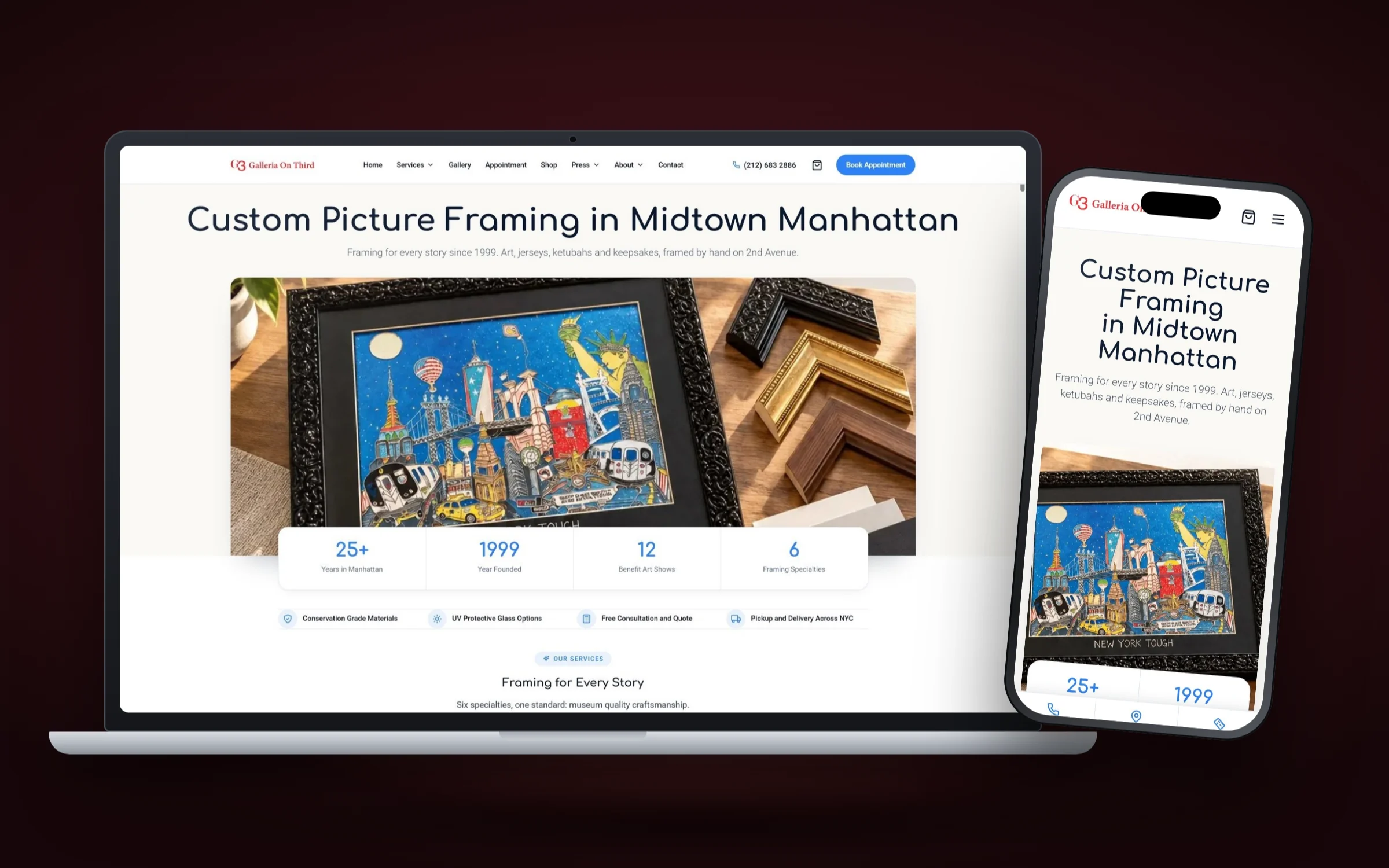
The frame shop website case study for Galleria On Third opens with “The results, framed” and a subhead that does a lot of work: “Every number comes from the live accounts.” Then come the stats: a 4.9 star Google rating from 314 reviews, a 98% GTmetrix performance score, 47.6% more site interactions week over week and 3.09K search impressions in the first 8 days of tracking.
Notice that the case covers several kinds of work (the website, Google Ads, SEO and reviews) and each gets its own short section with its own proof. The reader who cares about ads can jump to the ads section.
What to copy: when your engagement had several parts, give each part its own heading and its own evidence. One giant “Results” block buries the detail.
3. Porter Global Security: the audit makes the problem real
In the Porter Global Security redesign case study, the problem section isn’t a vague “the old site was outdated.” It’s a section headed “What the old website got wrong,” listing specific issues: the company name as the headline followed by a long italic sentence, no federal background or numbers above the fold, one small Contact Us button, and on mobile, seven lines of italic text before any photo or button.
Then there’s a drag slider comparing the old and new homepage, and a client review headed with Stacey Porter’s words: “I couldn’t be more pleased with the results.”
What to copy: describe the before state so precisely that a prospect thinks “that’s my website.” Then let a before and after visual carry the proof that words can’t.
4. JT Public Relations: context that sets the stakes
The JT Public Relations case study spends its early lines on who the client is: a New York firm with 20+ years in theatre PR and 200+ productions represented, with press coverage across outlets like The New York Times and Variety. That context makes the problem sting. The old hero said “Full Service Public Relations Firm” over a busy Times Square photo, and the “Latest News” section was empty apart from a button.
The results are qualitative, and the page is upfront about it. Each outcome is a short labeled claim, like “Authority up front” and “One path to a conversation,” explained in a sentence.
What to copy: a strong reputation plus a weak website is a story every established consultant understands. Lead with the reputation so the gap is obvious.
5. Harman PhD Consulting: proof from a referral
The MedTech consultant website case study for Harman PhD Consulting doesn’t report traffic or conversions. Its strongest outcome is simpler: after launch, Michael Harman referred a fellow founder to us for a new startup website. That’s a verifiable action, and to a prospect it says more than a percentage would.
The case also explains the thinking behind specific choices, such as six service cards written as decisions buyers face rather than job titles, and credentials placed directly under the first call to action.
What to copy: if you don’t have metrics, look for behavior. A referral, a renewal, a second project or a client who now updates the site on their own are all real outcomes you can state plainly.
6. Risk Mitigation Technologies: the client tells it on video
The threat assessment website case study for Risk Mitigation Technologies opens with “The threat assessment website design brief in three lines,” a quick summary for skimmers. A few sections later comes a video of founder Joseph Paul Manley talking about the move from his LinkedIn presence to his new website.
The page then walks through “5 decisions behind this threat assessment website design,” including one clear call to action (“Request a Confidential Consultation”) repeated at key decision points.
What to copy: a brief at a glance box helps the skimmer, and a short video from the client helps the skeptic. If your client is comfortable on camera, even two minutes recorded on a call is worth asking for.
7. Secured and Prepared Consulting: a visual case for visual work
Not every case study is about a website. The expert witness LinkedIn branding case study for this workplace violence prevention firm centers on the banner itself: “Safer Organizations Before a Crisis Hits,” a line naming four roles (Expert Witness, Consultant, Speaker and Author) and an “As Seen On” strip of national media. The challenge was specific too: show four roles without crowding the banner.
What to copy: if your work is visual, the deliverable should be the hero image. Then explain the constraint you solved, because constraints are what make design decisions look smart rather than arbitrary.
What these consultant case study examples have in common
Read them back to back and a few patterns jump out.
- The first screen carries the proof. Either a number, a before and after slider or the deliverable itself.
- Problems are written as lists of specifics, not one adjective like “outdated.”
- The approach is framed as decisions. “5 decisions behind” reads better than “our process,” because decisions show judgment.
- Proof matches what was actually measured. Search Console numbers when there’s SEO data, quotes and visuals when there isn’t. Nothing is padded.
That last point is the one people skip. I’ve seen consultants write “increased engagement significantly” when they have no data at all. It’s tempting. It also reads exactly like what it is. A careful qualitative outcome (“the client now updates the site himself”) beats a vague quantitative one every time.
A reusable outline for your own case study
Here is the outline we follow. Copy it into a document and fill one section at a time.
- 01
Headline with the outcome
Name the client (or client type) and the result in one line. If you have no number, name the change, such as "from a dated site to a clear first screen."
- 02
At a glance box
Client, industry, location, services and platform in three to five short lines.
- 03
Client context
Who they are and who they serve, with one or two facts that show their standing.
- 04
The problem, in specifics
List what was going wrong in concrete terms a peer would recognize. Quote the old headline or button text if you can.
- 05
The decisions you made
Three to five choices, each with a one sentence reason. This is where your expertise shows.
- 06
Proof
Sourced numbers with time frames, a client quote, before and after visuals or a verifiable outcome like a referral.
- 07
Lessons for the reader
Two or three takeaways a prospect can apply even if they never hire you.
- 08
Next step
One clear invitation, such as booking a call, placed at the end and in the header.
Can a case study work without numbers?
Yes. Most consulting work doesn’t produce a clean before and after metric within a few months, and many clients won’t share revenue figures anyway.
When you don’t have numbers, use stronger evidence of other kinds: the client’s own words, visuals of the deliverable, a description of what the client can now do that they couldn’t before, or a follow on action like a referral or a second project. And say plainly that the case reports qualitative outcomes. Readers trust you more when you don’t stretch.
Where to put your case studies
A case study nobody finds doesn’t sell anything. Link the most relevant one from each service page. Feature one or two on your homepage. Add a short version to proposals. Post the before and after image on LinkedIn with a few lines about the problem. And keep them all on one hub page, organized by type of work, like our case studies hub or the SEO case studies page where every figure comes from Search Console.
If your write up feels flat, the problem is usually the copy rather than the structure. Our website copywriting tips cover how to make each line pull its weight.
Frequently asked questions
What should a consultant case study include?
A results headline, brief client context, a specific problem, the key decisions in your approach, proof such as numbers, quotes or visuals, and one clear next step.
How long should a consulting case study be?
Long enough to cover the problem, approach and proof without filler. A web case study often runs 600 to 1,500 words, with a summary box at the top for readers who only skim.
Can I write a case study if my client wants to stay anonymous?
Yes. Describe the client by type, size and situation instead of name, and get their written approval of the final draft. The structure stays the same.
What if I don't have measurable results?
Use client quotes, before and after visuals and verifiable outcomes like a referral or repeat project. Say clearly that the outcomes are qualitative rather than inventing numbers.
How many case studies does a consultant need?
Three good ones that match the clients you want is a solid start. Add more as you finish projects, and group them by service once you have several.
Where can I learn the full process of writing one?
Our guide on how to write a case study covers choosing a project, interviewing the client and a template you can copy.
Turn your best project into proof
You probably already have a case study sitting in your inbox: a client who was happy, a before and after you’re proud of, a referral that came out of nowhere. Pick one, follow the outline above and publish it. The second one is always faster.
If you’d like a website where case studies are built in from the start, see our website design services and browse the website design case studies, or get in touch for a free homepage concept.