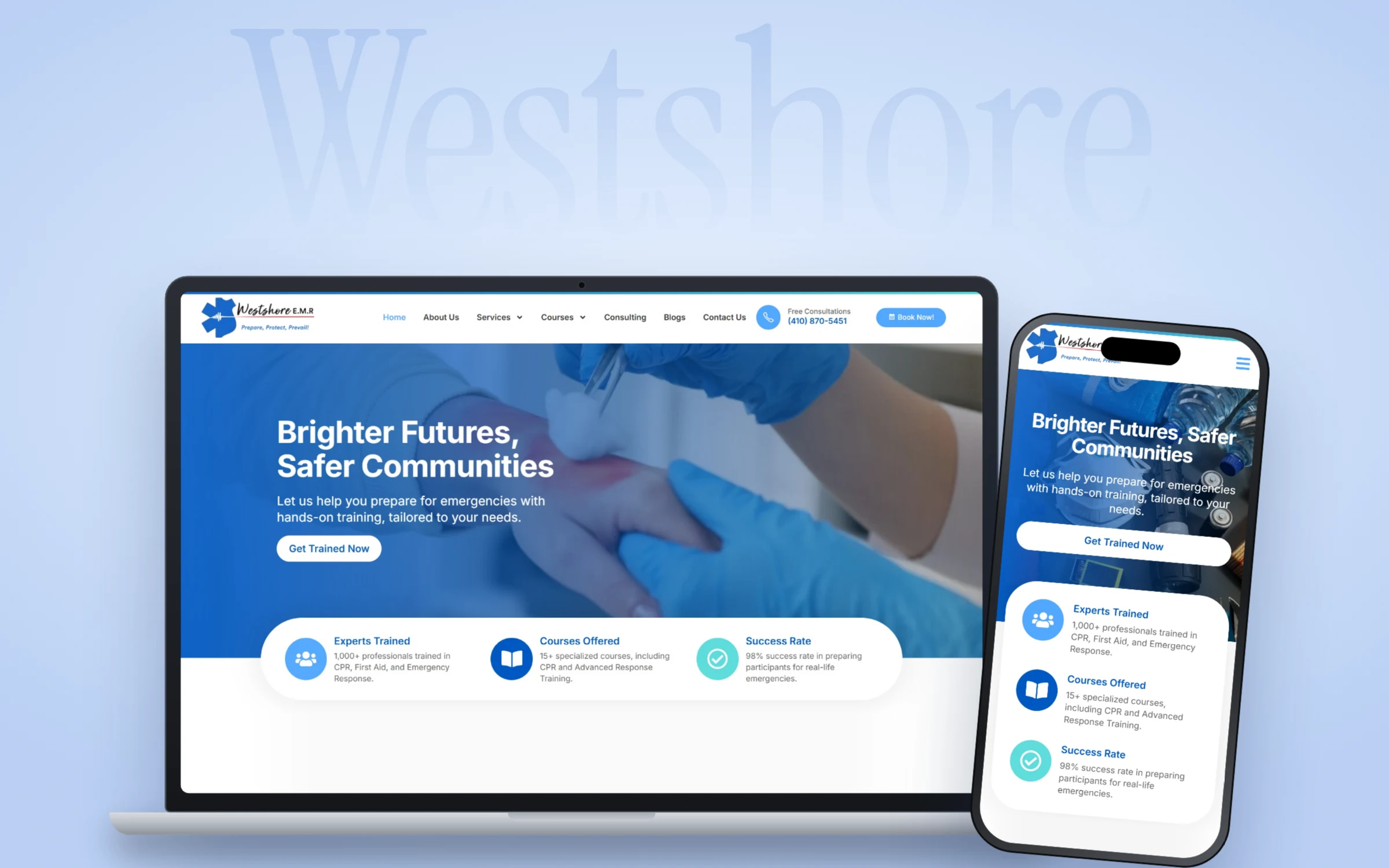
Quick answer: A one page website works for a consultant when most visitors already know your name (referrals, LinkedIn, talks) and you sell one main service. It costs you clients once you need to rank on Google for several services or audiences, because one URL can only target a narrow set of searches. Then it is time for separate pages.
A one page website is the most common thing new consultants ask us for. It’s fast to build, cheap to run and easy to keep current. And for a lot of people it’s exactly right.
For others it quietly caps the business. The page can look great and still never get found for the searches that matter, or carry enough proof for a cautious buyer. This guide is our honest take, as people who build both, on when a single page site works, when it costs you work, and how to grow out of it without starting over.
Key takeaways
- One page sites are great at converting people who already know you. They are weak at being found by strangers.
- Google generally ignores the #section part of a URL, so every section shares one search listing.
- If you sell two or more distinct services, or serve two different buyers, plan for separate pages.
- Build your one pager so each section can later become its own page. That makes the upgrade cheap.
What a one page website is (and what it isn't)
A one page website puts everything on a single scrolling URL: a hero with your promise, a short about section, services, proof, maybe an FAQ and a contact form. The menu links jump to sections on the same page.
It’s different from a landing page, even though people use the terms loosely. A landing page is built for one campaign or one offer, usually traffic you paid for or sent from an email. A one page website is your whole online presence. Same layout, different job. (If you’re running ads, our guide to landing page design covers that case.)
When a one page website works for consultants
We’d happily build a one pager for you if most of these are true:
- Your work comes from people who already know your name. Referrals, LinkedIn connections, conference talks, former colleagues. They type your name or click a link. They aren’t searching “HR consultant Chicago.”
- You sell one main thing. One clear service, one clear buyer. “Fractional CFO for early stage healthcare startups” fits on one page. Five service lines for three industries don’t.
- You’re still testing your positioning. In year one, your offer will change. A single page is quick to rewrite.
- You need something credible live this month. A clean one pager beats an unfinished five page site every time.
In that situation, a one page site does its job well: it confirms you’re real, shows your credentials and makes booking a call easy. Mobile visitors also like it, because scrolling on a phone is easier than hunting through a menu.
Where a single page site costs you clients
Start with search. No amount of effort fixes this one. Google’s own documentation says Google Search generally doesn’t support URL fragments, the #services or #about part of a link. So your whole site is one URL competing for one cluster of searches. You can rank that page for your name and maybe one core phrase. You can’t rank it separately for “workplace violence prevention training,” “threat assessment consultant” and “security expert witness.” Those are different searches with different intent, and each deserves its own page.
Then there’s depth. A cautious buyer (a school superintendent, a general counsel, a board chair) wants to read a real services page, a case study and your background before calling. Cram all of that onto one page and it becomes a very long scroll that nobody finishes. Cut it down and the buyer doesn’t get enough to trust you.
And there’s nowhere to put new things. Articles, speaking topics, media appearances, new services. A one pager has no home for them, so they never get published, so you never build the kind of content that brings strangers in.
Here’s the moment it usually bites. A consultant gets a referral to a big organization. The referrer says “look him up.” The procurement person searches, finds one page with three service bullets, and moves to the next name on the list, the one with a proper services page and two case studies.
One page vs multi page website: a quick comparison
| One page website | Multi page website | |
|---|---|---|
| Best for | Referral led work, one service, new practices | Several services or audiences, search traffic, larger buyers |
| Search reach | Your name and one core phrase | A page per service, location or audience |
| Room for proof | Short testimonials and logos | Full case studies, credentials, media pages |
| Build time | Shortest | Longer, depends on page types |
| Upkeep | Very easy | Easy with a good CMS |
| Analytics | Needs scroll or event tracking to see what people read | Page views tell you most of what you need |
How to build a one page website that converts
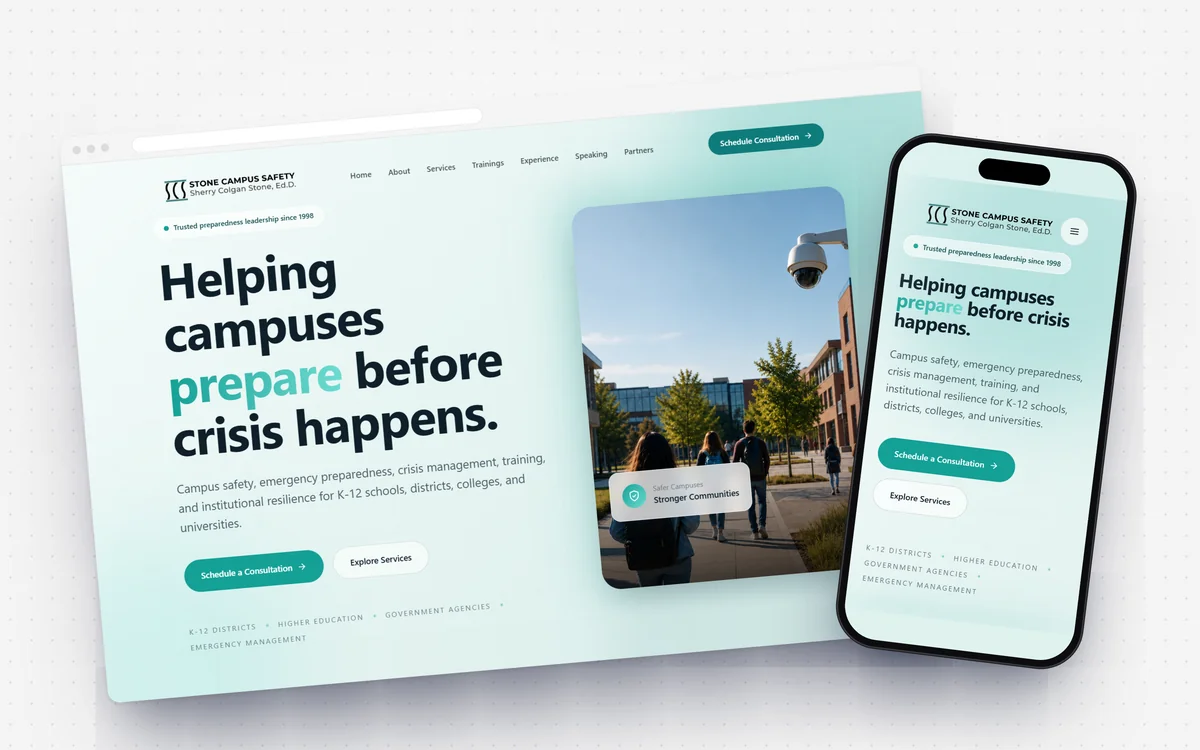
If a one pager is right for you, build it in this order. The sections mirror what a buyer needs to see, in the order they need to see it.
- 01
Write a headline that names the buyer and outcome
Who you help and what changes for them. Your job title alone is not a headline.
- 02
Put proof directly under the hero
Years of experience, certifications, notable clients or media. Do not make people scroll to the bottom to learn why they should trust you.
- 03
Describe services as problems you solve
Two to four short cards, each starting from the buyer's situation.
- 04
Add a short, human about section
A photo of you and a few lines on why you do this work. Real photos beat stock every time.
- 05
Answer the questions people ask on calls
A short FAQ handles cost, process and timing objections before the call.
- 06
Keep one call to action everywhere
A sticky header button plus a repeat after each section. Same words, same booking link.
Our consultant website design guide goes deeper on each of those elements, and most of it applies to a single page too.
When to graduate to more pages
Watch for these signs:
- You’ve added a second service line or a second type of buyer (say, attorneys as well as companies).
- You want to show up on Google for services, not just your name.
- You have case studies, articles or speaking topics with nowhere to live.
- Prospects keep asking questions the page should have answered.
The good news: if the one pager was built in clean sections, the upgrade is mostly cutting and expanding. Each services card becomes a services page. The about section becomes an about page with your full story. Testimonials grow into case studies. The homepage stays, now as a summary that links out.
That’s how we approach it with new consultants. We design the single page as if it were a homepage, so phase two takes days instead of a rebuild. If you’re unsure about the platform, our WordPress vs Squarespace comparison covers which ones make that growth easy.
Frequently asked questions
Is a one page website bad for SEO?
Not bad, but limited. A single URL can rank for your name and a narrow set of phrases. If you want to rank for several services or locations, you need separate pages, because Google generally treats the whole one pager as one page.
Is a single page website good for a small business?
Yes, when the business sells one main service and most customers arrive by referral, social media or a business listing. It is also a good starting point while the offer is still changing.
What is the difference between a landing page and a website?
A landing page serves one campaign or offer, often paid traffic. A website, even a one page website, is your full online presence and has to work for every kind of visitor.
Can I add a blog to a one page website?
You can add a separate blog section on its own URLs, and at that point you have a small multi page site. That is often the natural first step up.
How long should a one page website be?
Long enough to cover promise, proof, services, about, FAQ and contact, usually six to eight sections. If it needs much more than that, it probably wants to be several pages.
Can a one page website be upgraded later?
Yes, and it is cheap if each section was designed to become its own page. We plan our one page builds that way from the start.
Start small, build for the next step
A one page website is a smart first move for a lot of consultants and a quiet ceiling for others. The difference is whether your clients find you through people or through search.
If you’d like help deciding, or want a one pager built so it can grow, see our website design services and get in touch. We’ll start with a free homepage concept so you can see the direction first.