Quick answer: A medical device consultant wins clients by narrowing the offer to one stage, device type and function (regulatory, quality, commercialization or fractional CTO), then making credibility easy to verify: publications, submission experience described in general terms, academic and industry roles. Referrals from investors and incubators, LinkedIn, speaking and a focused website do the rest.
Most independent MedTech advisors are excellent at the work and quiet about it. They spent fifteen or twenty years inside device companies, labs or regulatory teams, and they assume the right people already know. Some do. But when a founder two states away searches for a medical device consultant the week before a board meeting, the advisor with a clear niche and a credible website gets the call.
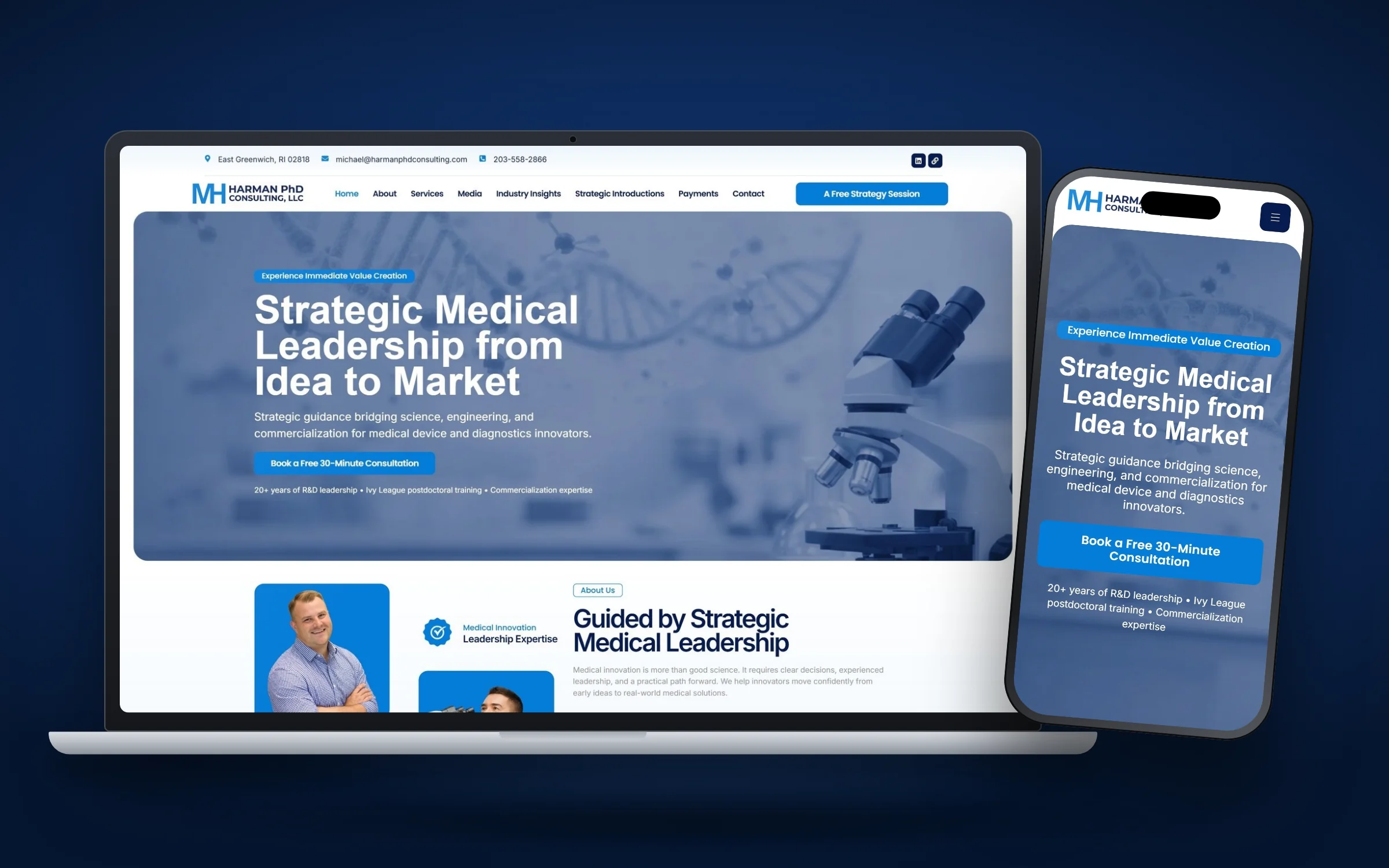
This guide is about the marketing side of medical device consulting: how to position yourself, what proof MedTech buyers look for, and the channels that actually bring in work for regulatory, quality, commercialization and fractional CTO advisors. We’ll use a real example throughout, the website we built for Harman PhD Consulting, a MedTech and diagnostics advisory firm in Rhode Island.
Key takeaways
- Position by stage, device type and function. “Fractional CTO for diagnostics startups preparing to raise” beats “MedTech consulting.”
- Your proof has to be checkable: publications with dates, named affiliations, testimonials with full names and companies.
- Describe regulatory experience accurately and in general terms. Never imply you can guarantee an FDA outcome.
- Investors, incubators and other consultants are the best referral sources. Make it easy for them to forward you.
- Your website is where every referral checks you out, so it has to answer “is this person credible for my stage?” in seconds.
Why medical device consulting is sold differently
The buyers are scientists, engineers, clinicians and investors. They read carefully, they distrust vague claims, and the stakes of hiring the wrong advisor are high: a missed design control or a weak regulatory strategy can cost a startup a funding round. Sales cycles are slow because the decision usually involves a founder, a board member or two, and sometimes an investor doing diligence.
An experienced consultant on the Elsmar Cove quality forum put the dynamic simply: “people are looking to solve problems not buy benefits.” Companies hire outside help when they face a confusing, expensive problem. Your marketing has one job: make it obvious which problem you solve, for whom, and why you’re safe to trust with it.
That changes the playbook. Cold outreach at volume rarely works here. Clever ads don’t either. What works is a narrow position, visible proof, and being present in the rooms (physical and online) where founders and investors ask each other “who do you use?”
Position your medical device consulting practice by stage, device type and function
“Medical device consultant” covers hundreds of very different jobs. A founder doesn’t want a generalist. They want someone who has been exactly where they are. So define your niche on three axes.
Stage. Where in the product life does the client sit when they need you?
| Stage | Typical buyer | What they need |
|---|---|---|
| Concept and feasibility | Founders, academic inventors | Technical roadmap, regulatory pathway view, investor ready story |
| Development and verification | Startup leadership teams | Design controls, quality system setup, testing strategy |
| Regulatory submission | Teams nearing a milestone | Submission planning and documentation support |
| Launch and commercialization | CEOs, commercial leads, investors | Market access, positioning, partnerships |
| Scale and postmarket | Growing companies | Quality maturity, process, team building |
Device type and class. The FDA explains that device classification is risk based, with Class I covering the lowest risk devices and Class III the greatest. The FDA lists several premarket submission types, including the 510(k), the De Novo request for novel low to moderate risk devices with no predicate, and premarket approval (PMA) for Class III devices. If your experience sits mostly with one pathway or one technology (diagnostics, implantables, software as a medical device), say so. Buyers search and ask for exactly that.
Function. Regulatory affairs, quality systems, clinical strategy, R&D leadership, commercialization, or a fractional executive role. Pick the one or two you’re known for.
Put the three together and you get a positioning line someone can repeat: “Fractional CTO and commercialization advisor for diagnostics startups.” That’s close to how Michael Harman, PhD describes his own practice, and it’s why his site’s headline, “Strategic Medical Leadership from Idea to Market,” works. It names the span of stages he covers and leaves no doubt about the industry.
Selling fractional CTO work to MedTech startups
Fractional CTO is one of the fastest ways for a senior technical leader to build a practice, because early stage device companies need executive judgment long before they can afford a full time executive. But “fractional CTO” alone is vague. Founders want to know three things before they book a call: what decisions you’ll own, how many days a month you work, and what the company looks like when you hand off.
Write your services as decisions, not titles. On the Harman PhD Consulting site we wrote the service cards around the decisions a MedTech team actually faces, and paired them with a four step process (Listen and Assess, Define the Path Forward, Execute with Focus, Scale and Support) so a founder can picture the engagement before the first call.
Credibility signals medical device consultant clients look for
In MedTech, credibility is something the buyer checks. They will look you up on LinkedIn, search your name on PubMed or Google Scholar, and ask a mutual connection. Make that easy.
- Publications and research. Peer reviewed papers, white papers, conference posters. List them with the source and date. On Harman’s site, a “Featured In” section shows interviews, thought leadership articles, peer reviewed research and white papers on diagnostics, each with its source and date.
- Academic and clinical background. Degrees, fellowships and affiliations, named precisely. Harman’s clinical postdoctoral fellowship at Brown University and Rhode Island Hospital sits right in his founder introduction, and his footer lists academic affiliations including Brown University and UConn.
- Industry roles. Former companies and titles, years of experience, the kinds of teams you led. Harman’s site states more than 20 years of MedTech R&D and leadership.
- Regulatory and submission experience, described generally. “Supported design control and submission planning for Class II diagnostic devices” is honest and useful. Client names, device details and outcomes usually aren’t yours to share, and you should never imply you can guarantee a clearance or approval.
- Named testimonials. Full name, title and company. One line from a recognizable company outweighs ten anonymous five star quotes. Harman’s homepage carries testimonials from people at GSK, Exact Sciences and Alnylam Pharmaceuticals, including this one from a GSK director: “Michael is a valuable partner. I would gladly work with him again.”
Place credentials close to the first call to action. On Harman’s homepage they sit directly under it, so a visitor sees the proof at the moment they’re deciding whether to book.
Your medical device consultant website
Every referral, LinkedIn post and conference conversation ends at your website. The visitor arrives with one question: is this person credible for my stage and my device? Answer it on the first screen.
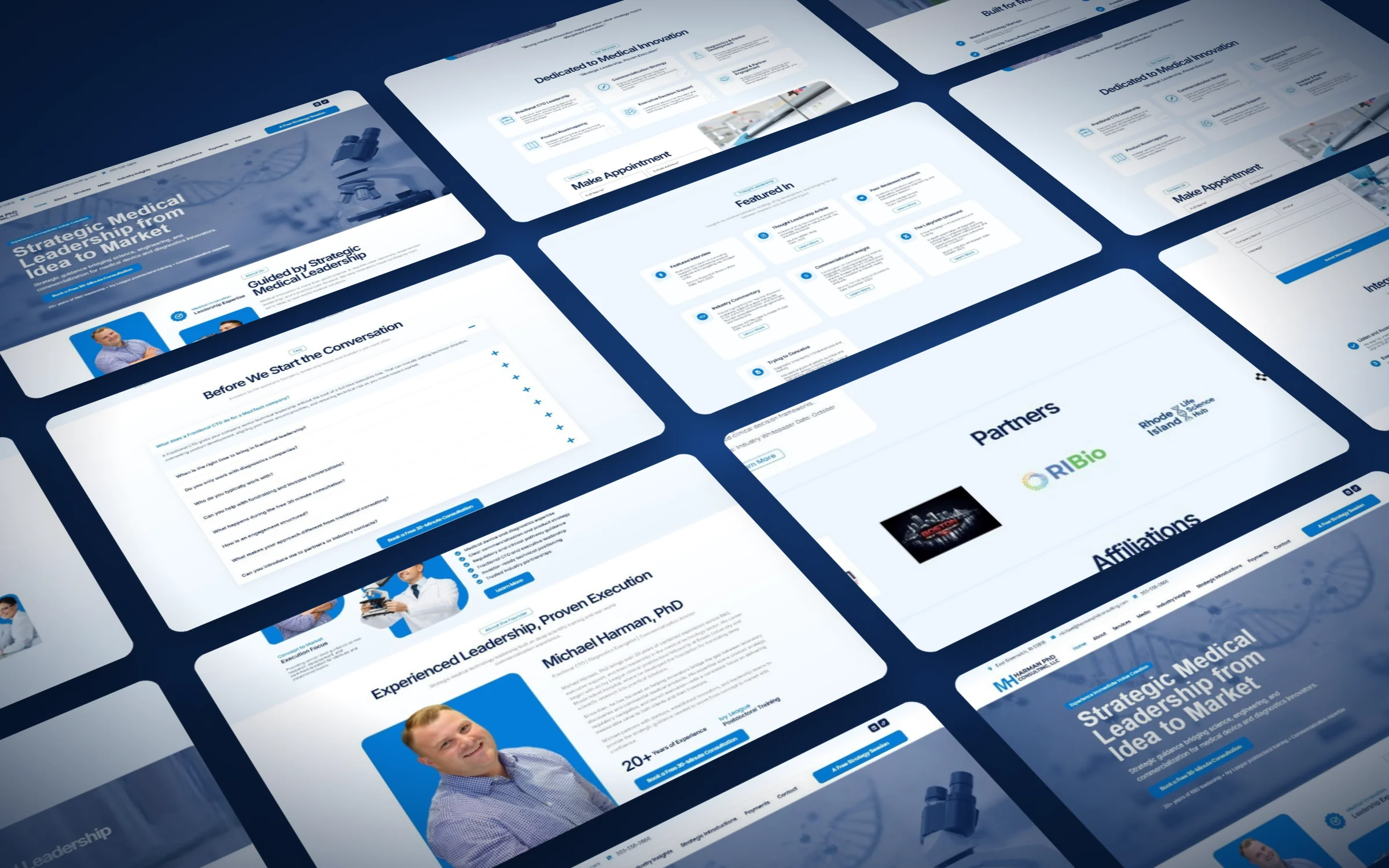
Here’s the homepage structure we used for Harman PhD Consulting, in order:
- Hero with the promise, the audience (medical device and diagnostics innovators) and a free 30 minute consultation
- Six strengths, from regulatory pathway guidance to investor ready positioning
- Founder introduction with education and a booking button
- Six service cards
- A short appointment form
- The four step process
- Testimonial carousel
- An audience section for startups, founders, scaling teams and investors
- Proof: interviews, articles, research, partners and academic affiliations
The full site includes Home, About, Services, Media, Industry Insights, Strategic Introductions, Payments and Contact pages. The visual direction is deep navy and medical blue with laboratory imagery (microscopes, lab benches, DNA strands) and Harman’s own portrait. It looks like science, not like a generic consulting template, and that matters to a scientist evaluating you.
Two details people skip. First, write a separate section or page for each audience (founders, scaling teams, investors), because an investor doing diligence reads differently from a founder. Second, make booking frictionless: a header button, booking buttons after key sections, and a short form. More on this in our page on web design for MedTech consultants.
LinkedIn and your personal brand
For an independent advisor, the firm is you. Founders and investors will look at your LinkedIn profile before or right after your website, and the two should tell the same story with the same positioning line.
- Use the headline for your niche, not your old job title. Our LinkedIn headline examples show how to fit stage, audience and function into one line.
- Turn the Featured section into a proof shelf: a paper, an interview, a talk, your website.
- Post about decisions your buyers face. A short note on what you’d check before a design freeze will get more of the right attention than a repost of industry news.
- Ask past colleagues and clients for recommendations that name the problem you solved.
We go deeper on this in personal branding for consultants.
Speaking at industry events
MedTech is a conference industry. Large events like AdvaMed’s MedTech Conference get the attention, but for an independent consultant the better stage is usually smaller: a regional life sciences association, a university innovation program, an accelerator demo day, a webinar for an incubator’s portfolio companies. The audience is founders at exactly the stage you serve, and the organizers are often looking for practical speakers.
Pick one talk built around a decision (“What investors check in your regulatory strategy before a seed round”) and give it repeatedly. Record it when you can and put it on your website’s media page. Each talk becomes proof for the next one.
Referrals from investors, incubators and other consultants
In this field, the best leads arrive through people who sit next to many founders at once. Angel groups, venture partners, incubator directors, university tech transfer offices and other consultants with adjacent skills (a regulatory specialist who doesn’t do commercialization, for example) all get asked “do you know someone who can help with this?”
Make yourself easy to recommend. Give each referral partner a one line description of who you help and a link that explains it. Offer something useful to their portfolio: office hours, a short workshop, a review of a pitch deck’s technical slides. And send referrals back. Referral networks run on reciprocity.
We’ve seen this work in our own small way. After his site launched, Michael Harman introduced a fellow founder to us for a new startup website. Experts refer to people they trust, and a good experience is what earns the introduction.
MedTech marketing content that buyers actually read
MedTech marketing for a solo advisor doesn’t need a content team. It needs a few pieces that show how you think. Good formats:
- Short articles on common decisions, written for founders (“Building your first quality system: what to do now and what can wait”).
- Plain language explainers of general processes, citing official sources like FDA guidance rather than offering advice on a specific device.
- Interviews and podcast appearances, collected on one media page.
- A monthly email or LinkedIn newsletter for founders and investors in your network.
Keep claims precise and general. If you write about regulatory topics, link to the FDA’s own pages and avoid anything that reads like advice for a particular product. Our guide to thought leadership content covers how to turn client conversations into articles without giving away confidential details.
A 90 day marketing plan for a new medical device consultant
If you’re just going independent, this is the order we’d suggest:
- 01
Write your positioning line
One sentence naming stage, device type or technology, and function. Test it on three people who know the industry.
- 02
Fix your LinkedIn profile
Headline, About section, Featured section and two or three new recommendations, all matching the positioning line.
- 03
Launch a focused website
Homepage, About, Services, Media or Insights, and Contact with online booking. Credentials and named testimonials near the top.
- 04
List twenty referral partners
Investors, incubators, tech transfer offices and complementary consultants. Contact five a week with a short, specific note.
- 05
Book one speaking slot
A webinar or local event for founders. Record it and add it to your site.
- 06
Publish two pieces of content a month
One article on your site and a LinkedIn post that points to it. Consistency beats volume.
Frequently asked questions
How do medical device consultants find clients?
Mostly through referrals from former colleagues, investors, incubators and other consultants, backed by a clear LinkedIn profile and website that confirm the referral. Speaking at founder focused events and publishing useful content add steady inbound leads over time.
What is a fractional CTO in MedTech?
A senior technical leader who works part time for a device or diagnostics company, owning technical strategy and key decisions until the company can hire a full time executive. It suits early stage teams preparing to raise or approaching regulatory milestones.
Should a medical device consultant specialize?
Yes. Buyers look for someone who has handled their stage, technology and problem before. A narrow position is easier to remember, easier to refer and easier to rank for in search.
Can I mention FDA submissions I worked on?
Describe the experience in general terms, such as the device class, pathway or your role, and only share client names or outcomes with permission. Never imply you can guarantee clearance or approval.
What should a medical device consulting website include?
A headline naming your audience and outcome, credentials near the first call to action, services written as decisions, named testimonials, a media or publications section and easy booking. Add separate content for founders and investors.
Is LinkedIn worth it for MedTech consultants?
Yes, because founders and investors check it before they call. A focused headline, a Featured section with your best proof and occasional posts about real decisions are enough to start.
Make it easy to choose you
Good medical device consultants rarely lose work to better consultants. They lose it to advisors who are easier to find and easier to trust at a glance. A narrow position, proof a buyer can check and a steady presence where founders and investors gather will close most of that gap.
If your website doesn’t yet say who you help and why you’re credible, take a look at our approach to web design for MedTech consultants, or contact us for a free homepage concept before you commit to anything.