Quick answer: An expert witness CV is a factual record of the qualifications that make you competent to give an opinion in a case: education, licenses and certifications, relevant work history, publications from the last 10 years, presentations, and a testimony list covering at least the last 4 years. Keep it dated, accurate and consistent with your website and LinkedIn.
Your expert witness CV has two readers who want very different things. The attorney thinking about retaining you wants to see quickly that you fit the case. Opposing counsel wants to find the one line that doesn’t match your deposition, your website or a certificate that lapsed in 2019.
So the CV isn’t a sales document. It’s evidence. Below is the format we recommend, what US rules require it to support, and the consistency checks attorneys run before they ever call you. We build websites for expert witnesses and see a lot of CVs, so the problems listed here are ones we see regularly.
Key takeaways
- Under Federal Rule 26, a retained expert’s report must cover qualifications, publications from the previous 10 years and testimony from the previous 4 years. Your CV and testimony list should make that easy.
- Accuracy beats length. Every date, title and credential will be compared to other sources.
- Keep the testimony list as a separate, updated document so you can attach it without reissuing your CV.
- Your website bio, LinkedIn profile and CV must tell exactly the same story.
What US rules expect your expert witness CV to support
In federal court, a retained testifying expert has to provide a written report under Federal Rule of Civil Procedure 26(a)(2)(B). Among other things, it must include:
- “the witness’s qualifications, including a list of all publications authored in the previous 10 years;”
- “a list of all other cases in which, during the previous 4 years, the witness testified as an expert at trial or by deposition;”
- “a statement of the compensation to be paid for the study and testimony in the case.”
Most experts satisfy the qualifications piece by attaching a CV, and the testimony piece with a separate list. State courts have their own rules, many modeled on the federal one, so check with the retaining attorney. The practical point: if your CV already holds a clean 10 year publication list and you keep a running testimony list, every disclosure is a quick copy job instead of a weekend of digging through old files.
Expert witness CV format: the sections, in order
There’s no official expert witness CV template, but attorneys expect a familiar order. This is the structure we suggest, adapted from what experienced experts and retaining attorneys tend to prefer:
| Section | What goes in it | Common mistake |
|---|---|---|
| Header | Name, credentials after the name, city and state, phone, email, website, and the date the CV was last updated | No date, so nobody knows if it is current |
| Summary | Two or three factual lines on your field and current practice | Marketing adjectives like “leading” or “renowned” |
| Education | Degree, field, institution, year | Listing a degree as completed when it was not |
| Licenses and certifications | Name, issuing body, number if public, date earned, current status | Keeping an expired certification without marking it expired |
| Professional experience | Title, employer, dates (month and year), short factual duties | Unexplained gaps, or dates that differ from LinkedIn |
| Publications | Full citations, at least the last 10 years, in one consistent style | Missing an op ed or blog post that opposing counsel later finds |
| Presentations and teaching | Title, organization, city, year | Vague entries like “various conferences” |
| Affiliations | Current memberships and roles | Lapsed memberships listed as current |
| Testimony list (separate document) | Case caption, court, docket number, year, deposition or trial, retained by plaintiff or defense | Folding it into the CV, so it goes stale |
Two to six pages is typical for a working expert. Long careers can summarize older roles in a single line. Leave out hobbies, references and anything personal.
Expert witness resume vs CV: which one do you need?
In US litigation the terms get used loosely, but the document is the same: a complete record, not a one page resume tailored to win a job. A resume leaves things out on purpose. That’s exactly what an expert can’t do, because an omission looks like concealment when it surfaces at deposition.
Where a shorter version helps is marketing. A one page summary on your website, in a directory profile or in an email to a new attorney is fine, as long as every fact in it also appears in the full CV. The UK Expert Witness Institute makes a similar point in its note that an expert witness CV is not the same as a professional CV: a website can work as an online CV, but all versions must match.
What attorneys flag on an expert witness CV
Before an attorney retains you (and certainly before opposing counsel deposes you), someone runs a set of quick checks. These are the ones that cause trouble most often:
- Dates that don’t match. Your CV says you left an agency in 2018; LinkedIn says 2017. Small, but it invites a whole line of questions.
- Credentials without status. A certification listed with no date or one that expired. Mark lapsed credentials as such, or remove them.
- Inflated titles. “Director” when the org chart said “Deputy Director.” Use the exact title you held.
- Publications missing from the list. Opposing counsel will search your name. If an article or interview is out there and not on your list, expect to be asked why.
- A website that says more than the CV. Bold claims on a homepage (“the nation’s top expert”) get read aloud in depositions. Keep web copy as factual as the CV.
- Advocacy language. Phrases like “helping plaintiffs win” undermine the independence a court expects from an expert.
None of this means you need to sound dull. It means every claim should be something you could defend line by line under oath.
How to build or update your expert witness CV
If your CV hasn’t been touched in years, work through it in this order. Expect it to take an afternoon the first time and 20 minutes a quarter after that.
- 01
Gather source documents
Pull diplomas, license records, certification certificates, old org charts and a search of your own name for articles, interviews and talks.
- 02
Fix the facts first
Confirm every date, title and credential status against the source. Correct LinkedIn and your website at the same time.
- 03
Rebuild in the standard order
Header with an "updated" date, summary, education, licenses, experience, publications, presentations, affiliations.
- 04
Create a separate testimony list
At least four years back, with case caption, court, docket number, year, type of testimony and retaining side.
- 05
Remove anything you cannot defend
Adjectives, vague claims and outdated memberships. If a line needs explaining, rewrite it so it does not.
- 06
Set a quarterly reminder
Add new testimony, talks and publications as they happen, then save a PDF with the date in the file name.
Your CV, website bio and LinkedIn: one story, three formats
Attorneys rarely read your CV first. They usually find your website or LinkedIn, then ask for the CV. That makes consistency across all three the real test.
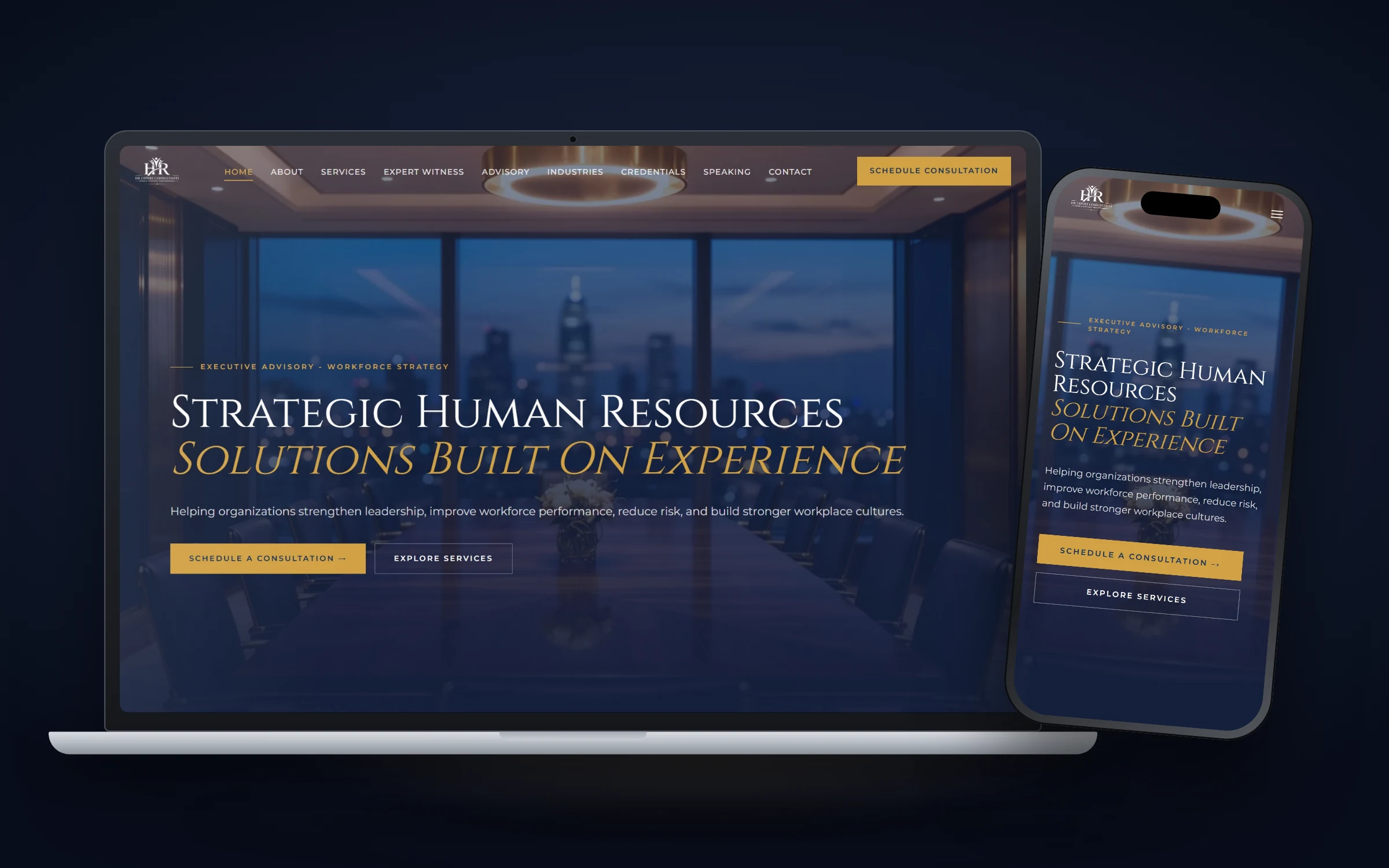
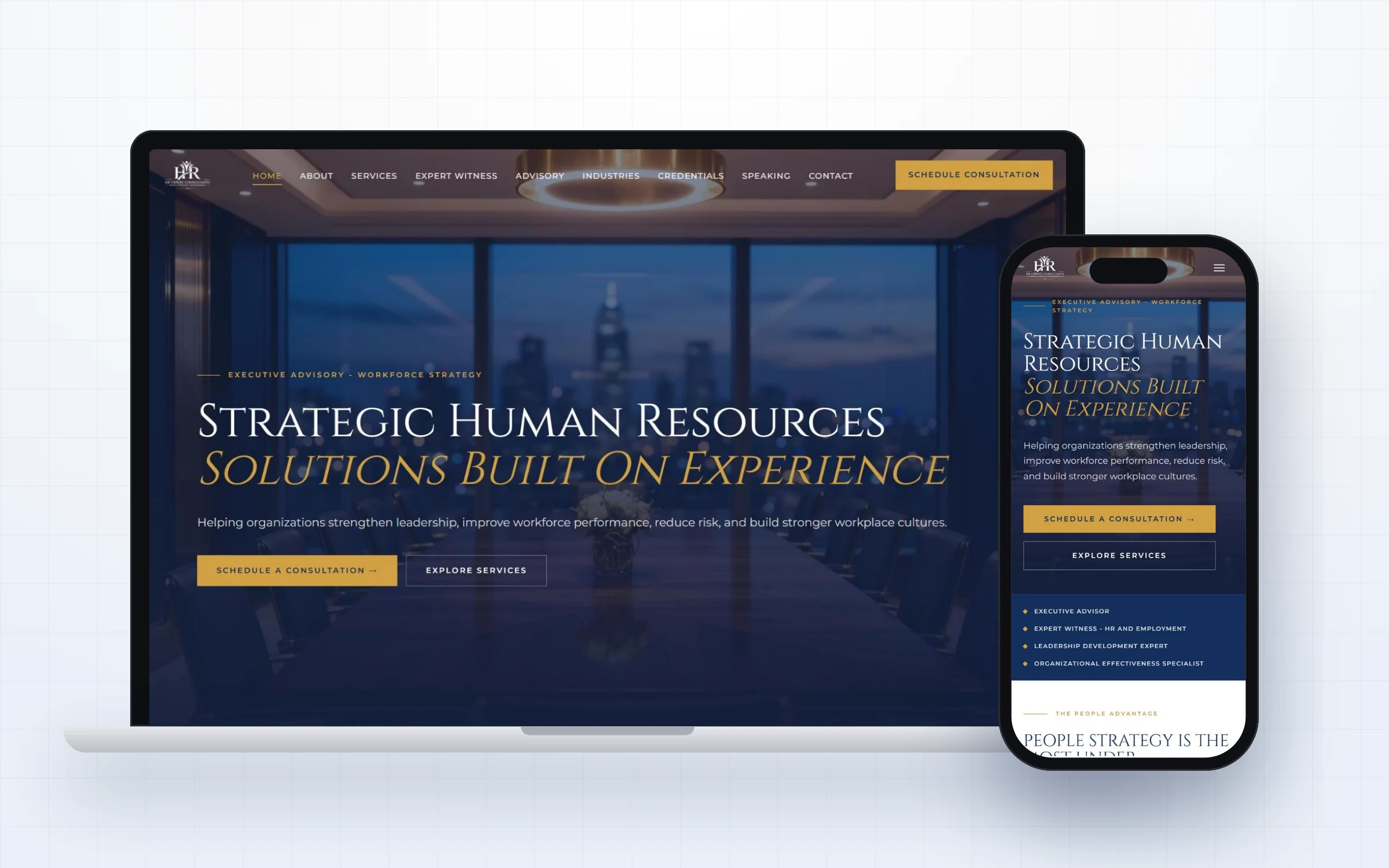
When we built the site for HR Expert Consultants, David Morris’s practice serving executives, boards and attorneys, we gave the credentials their own page and used scannable credential cards for his SHRM SCP, his master’s degree in human resources management and three decades of senior HR leadership. Those cards say exactly what the CV says, in fewer words. The expert witness page then lists practice areas in a format attorneys can scan quickly. You can see the build in the HR consultant website design case study.
Practical rules we follow on every expert site:
- Offer the CV as a dated PDF download from the expert witness page.
- Use the same job titles and dates on the website, LinkedIn and CV.
- Write the bio in plain English for the attorney, and let the CV carry the detail. Our guide on how to write an About page covers the bio side.
- Update all three together, the same day.
For the full page by page layout, read our post on expert witness website design.
Frequently asked questions
How long should an expert witness CV be?
Usually two to six pages for an active expert. Length matters less than completeness and accuracy. Summarize older roles instead of cutting them.
Should my testimony list be part of my CV?
Keep it separate. Federal Rule 26 asks for testimony from the previous four years, and a separate list is easier to update and attach without reissuing your CV.
Do I list cases where I consulted but did not testify?
Rule 26 asks for trial and deposition testimony. Consulting engagements are often confidential, so discuss with the retaining attorney before listing them anywhere.
Is there an expert witness CV template I can use?
Use the section order in the table above as your template. Plain formatting in a standard font works best, since the document may be filed, copied and read on screen.
Should I put my rates on my CV?
No. Keep fees in a separate fee schedule. The report itself must state compensation for the case under Rule 26.
What if my CV has an error that has already been produced in a case?
Tell the retaining attorney, correct it, and date the new version. Quietly fixing it without telling anyone is worse than the original error.
Keep the record clean and current
A good expert witness CV is boring in the best way. Accurate dates, current credentials, a full publication list and a separate testimony log, all matching what attorneys find online.
If your website or LinkedIn tells a different story from your CV, we can bring them into line. See our website design for expert witnesses or get in touch for a free homepage concept.