Quick answer: An author media kit is a ready to use set of materials that lets producers, podcasters and journalists book and introduce you without chasing you for details. Include bios in three lengths, headshots in several crops, the book cover and key facts, five key ideas, sample interview questions, past coverage and contact details. Host it on a press page.
A podcast producer has a slot to fill next Thursday. She has three possible guests. One sends a link to a tidy press page with a bio, a headshot and ten good questions. One sends a 14 MB PDF. One says “let me pull some things together.” Guess who gets the slot.
That’s the whole case for an author media kit. It isn’t about looking impressive. It’s about making yes the easiest answer. I design author and speaker websites and brand materials, and in this guide I’ll walk through exactly what goes into an author press kit, why an online press page beats a PDF for most people, and the sample questions section that almost everyone forgets.
Key takeaways
- Producers and podcasters want to say yes fast. Your kit exists to remove every reason to delay.
- Bios in three lengths and headshots in three crops cover nearly every request you’ll get.
- Sample interview questions are the most useful thing in the kit, and the most often missing.
- Keep the master version as a page on your website, with a PDF and a download folder linked from it.
What an author media kit is for
Different people use your kit for different jobs:
- Podcast hosts need an intro to read, a photo for the episode art and a list of questions to plan the conversation.
- Journalists need facts they can check quickly: your credentials, the book’s publisher and date, and a quote or two.
- Event and bookstore organizers need a bio for the program, a photo for posters and your speaking topics.
- TV and radio producers need to know you can talk in short, clear answers on a topic their audience cares about right now.
None of them want to read your whole book before deciding. Most won’t read it at all. The kit has to give them enough to book you and enough to make you sound good when they introduce you.
What to include in an author media kit
Here’s the full list, with what each piece is for. If you’re starting from scratch, do the first five and add the rest over time.
| Component | Details | Who uses it |
|---|---|---|
| Bios in three lengths | One line, about 100 words, and about 250 words, all in third person | Everyone |
| Headshots | High resolution, cropped horizontal, vertical and square, plus one candid or speaking shot | Podcasts, events, press |
| Book cover and facts | High resolution cover, title, publisher, date, ISBN, formats, page count, buy links | Press, bookstores |
| Key ideas | Five main ideas from the book and the problem it addresses | Hosts preparing an interview |
| Sample interview questions | Eight to twelve questions you answer well | Podcasts, radio, TV |
| Past coverage | Links to interviews, articles and talks, with dates | Producers judging if you’re a good guest |
| Endorsements | Short quotes with names and titles | Press, event organizers |
| Speaking topics | Two to four talk titles with one line each | Event organizers |
| Contact | Email, phone, publicist if you have one, social handles | Everyone |
IngramSpark’s guide to why you need an author media kit suggests a short bio under 100 words, a long bio under 300 words, and images at 300 dpi. Scribe Media’s media kit guide adds a document of five key ideas rather than a general synopsis, and a short audio clip of how to say your name if people often get it wrong. Both are good calls.
Bios in three lengths
Write them once, properly, and you’ll never scramble again. The one liner gets read aloud at the start of a podcast. The 100 word version goes in event programs and article footers. The 250 word version is for anyone who wants the full story.
Lead each one with what you’re known for and why it matters to this audience, not where you were born. Our guide on how to write an About page uses the same structure, and the bios should match it.
Headshots
Three crops of the same good photo cover most uses: horizontal for websites and article headers, vertical for programs and posters, and square for podcast art and social posts. Add one shot of you speaking or signing books if you have it. Our professional headshot tips cover what makes a photo look current and credible.
Sample interview questions: the part everyone forgets
Hosts are busy. Many interview several guests a week, and the best gift you can give them is a list of questions you answer well. It makes their prep faster, and it steers the conversation toward the stories you tell best.
Write questions that invite a story, not a yes or no. A template you can adapt:
- What made you write this book now?
- What’s the biggest mistake you see people make with [your topic]?
- Tell us about a moment in your career when this idea clicked.
- What do most people believe about [topic] that’s simply wrong?
- If a listener does one thing after this episode, what should it be?
- Who is this book not for?
- What surprised you while writing it?
- What’s changed in [your field] in the last few years that makes this urgent?
Test each one by answering it out loud in under two minutes. If you can’t, rewrite it or drop it.
Online press page or PDF?
Both, but the press page is the master. Here’s how they compare:
| Press page on your website | PDF media kit | |
|---|---|---|
| Easy to update | Yes, change it once | No, re export and resend |
| Downloadable images | Yes, full resolution | Images trapped inside the file |
| Copy and paste bios | Easy | Often awkward |
| Found in search | Yes, under your name | Rarely |
| Works as an attachment | No, it’s a link | Yes |
On a well built author website, the press page has the bios as plain text, headshots with download links, the book facts, sample questions and coverage. At the top, a button to download everything as one PDF, and a link to a shared folder with the full resolution images. Scribe Media recommends view only sharing on that folder so nobody can accidentally delete your files. Good idea.
Show past coverage the way PR firms do
Producers want proof you’ve done this before and done it well. PR firms understand this better than anyone because it’s their entire business.
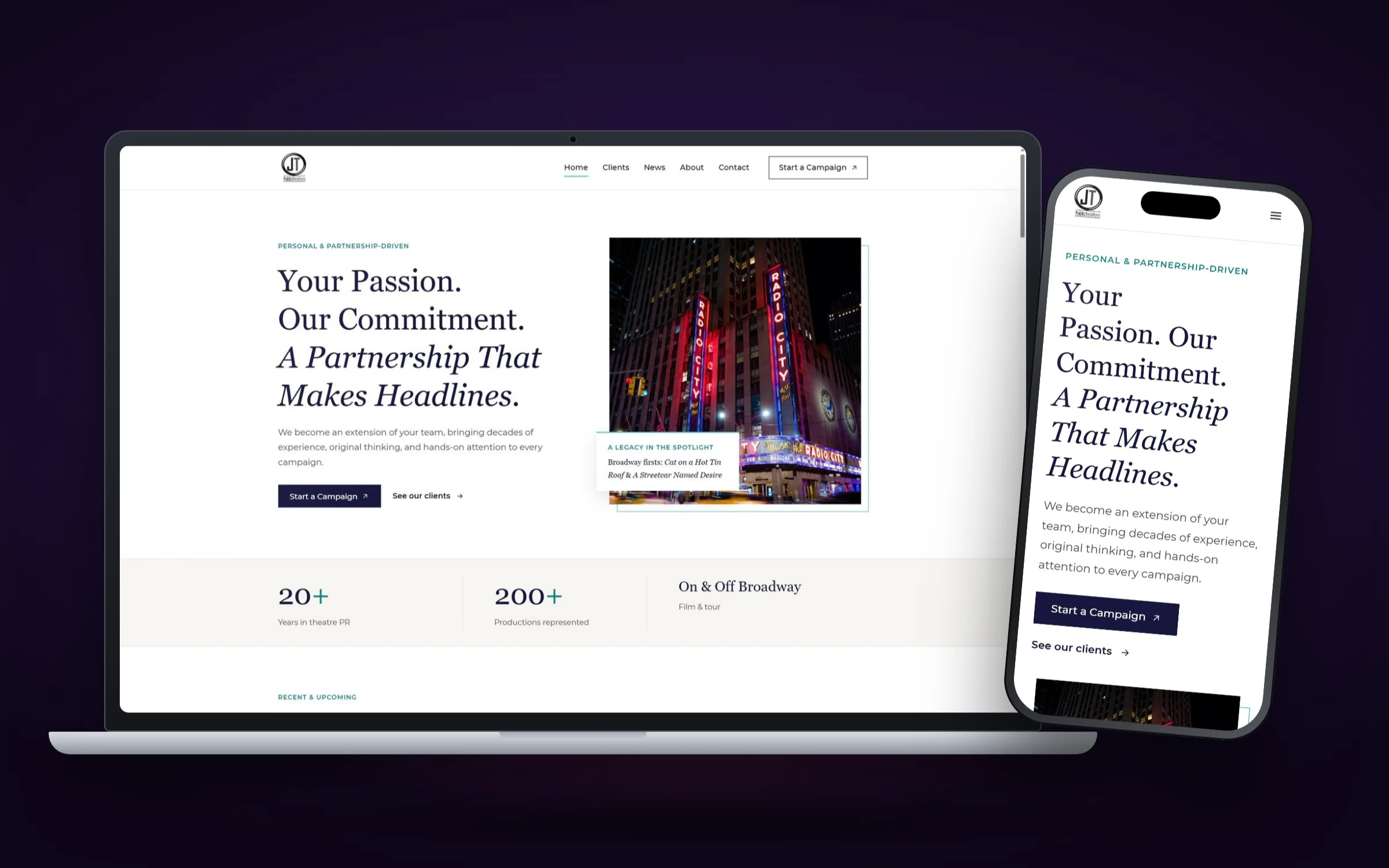
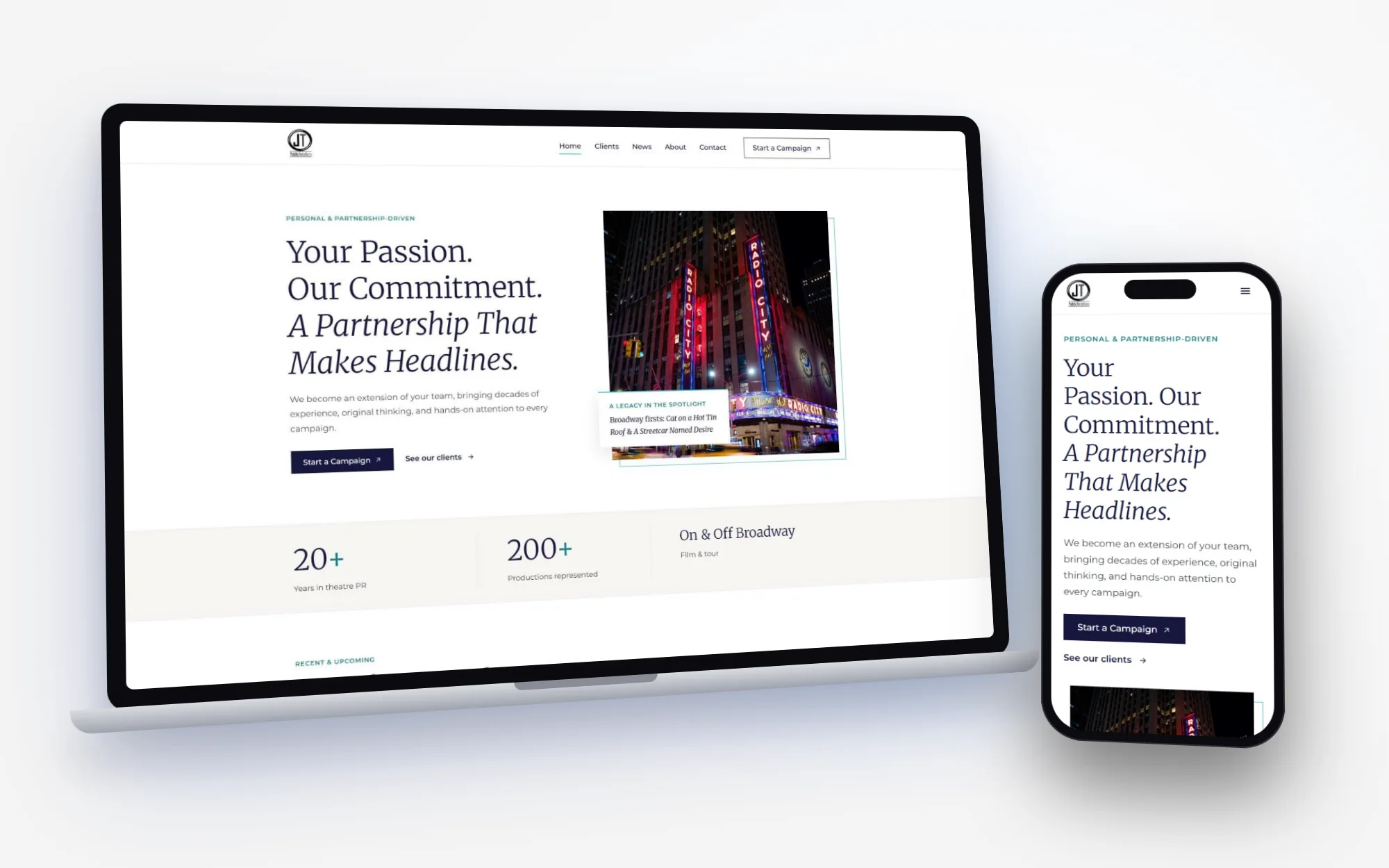
When we redesigned the site for JT Public Relations, a New York theatre PR firm, the old site had an empty “Latest News” section. The new homepage has a press band listing outlets where clients have appeared (The New York Times, Variety, Today, NPR and others), and a news section called “The latest from our clients” with real coverage cards. Each card shows where and when. That’s exactly how an author’s coverage section should work: outlet, date, a one line summary and a link.
If you only have a few interviews, show those few well. Three dated, linked appearances beat a vague “as seen on” logo strip with nothing behind it.
How to build your author media kit
You can put together a solid first version in a weekend:
- 01
Write your three bios
One line, about 100 words and about 250 words, all third person, leading with what you're known for.
- 02
Get your photos ready
Export your best headshot as horizontal, vertical and square crops at high resolution, plus one action shot.
- 03
List the book facts
Title, publisher, date, ISBN, formats, page count, buy links and a high resolution cover.
- 04
Pull out five key ideas
Short paragraphs on the main ideas and the problem the book solves.
- 05
Draft sample questions
Eight to twelve questions that lead to your best stories. Test each one out loud.
- 06
Gather coverage and endorsements
Dates, outlets and links, plus short quotes with names and titles.
- 07
Publish the press page
Put it on your site, add a PDF and a view only image folder, and link it from your email signature and LinkedIn.
Frequently asked questions
What is the difference between an author media kit and a press kit?
Most people use the terms interchangeably. Both are a set of materials for media and event organizers. Some reserve press kit for news announcements and media kit for the ongoing author package.
What should be in an author press kit?
Bios in three lengths, headshots, the book cover and key facts, five key ideas, sample interview questions, past coverage, endorsements, speaking topics and contact details.
Do I need a media kit before my book is published?
Yes, ideally a few months before. Podcasts and publications book guests well in advance, so a press page ready at preorder time catches those early opportunities.
Is an author one sheet the same as a media kit?
No. An author one sheet is a single page summary of the book for bookstores, libraries and buyers. The media kit is the larger set of materials for interviews and events.
Should I use a Canva author press kit template?
It's fine for a PDF draft. Still build the master version as a page on your website, so bios can be copied and images downloaded at full resolution.
How often should I update my media kit?
Whenever something changes: a new book, new coverage, a new photo or a new title. A quick review every few months keeps it current.
Make yes the easy answer
The best author media kit is the one that lets a producer book you in five minutes without sending a single follow up email. Get the bios, photos and questions right, keep it on your own site, and update it as your coverage grows.
If you’d like a press page and kit that match the rest of your brand, take a look at our brand identity design service, or contact us to talk it through.