Quick answer: Answer engine optimization (AEO) is the practice of shaping your content so AI tools and search features can pull a clear answer from it and name you as the source. For a consultant, that means question led pages, a direct answer in the first two sentences, honest schema, consistent facts about your firm everywhere, and outside mentions that back you up.
A few years ago, an HR director looking for help would type “workplace investigation consultant” into Google and click through ten results. Today a lot of them open ChatGPT or Google’s AI Mode and ask a full question instead: “Who should we hire to run an independent workplace investigation, and how long does one take?” They get a paragraph back. Maybe two or three names. Maybe a link.
Answer engine optimization is the work of making sure your expertise ends up inside that paragraph, with your name and a link attached. We already wrote a broad guide to AI search optimization for consultants that covers the whole picture, from crawlers to reputation. This post is narrower and more hands on. It’s about how to write and structure pages so an answer engine can actually use them, and how to tell if it’s working.
Key takeaways
- Answer engines (Google AI Overviews and AI Mode, ChatGPT search, Perplexity, Gemini) assemble answers from web pages, so the page that answers the question most directly has the best shot at being quoted.
- Google says there are no extra requirements or special markup needed for its AI features. AEO is good SEO with a sharper focus on answers.
- The core habit: put a short, self contained answer right under a question heading, then back it up with specifics only you can give.
- Measure with Search Console, a GA4 report for AI referrals and a monthly prompt log. None of these show the full picture, so use all of them.
What is answer engine optimization?
Answer engine optimization means preparing your content so it can become the answer itself. A search engine hands people a list of links. An answer engine reads those links for them and writes a reply. AEO is how you make your page easy to read, easy to trust and easy to quote in that reply.
The term isn’t new. SEO people used it years ago for featured snippets and voice assistant answers, back when the goal was to be the one sentence Alexa read out. What changed is the size of the answer. Generative tools now write whole paragraphs, compare options and recommend providers. That last part is why consultants should care.
Here’s what the main answer engines actually do, based on what the companies themselves publish:
- Google AI Overviews and AI Mode. Google says both may use what Google calls query fan out, which means running several related searches across subtopics and sources to build one response (see Google’s guide to AI features and your website and its AI Mode announcement). One question from your prospect can turn into five or six searches behind the scenes.
- ChatGPT search. OpenAI says any public website can appear, and that sites which block its search crawler won’t be shown in ChatGPT search answers (OpenAI crawler documentation).
- Perplexity. Perplexity says its crawler exists to surface and link websites in its results, and it recommends allowing it in robots.txt (Perplexity crawler documentation).
Notice the pattern. All of these tools search the live web and then summarize. If your page isn’t findable, or if it buries the answer under three paragraphs of throat clearing, it gets skipped.
AEO vs SEO: is answer engine optimization a separate job?
Mostly no, and I’d be suspicious of anyone who sells it as a completely separate service. Google is blunt about this. Its documentation says “There are no additional requirements to appear in AI Overviews or AI Mode, nor other special optimizations necessary,” and that you don’t need new machine readable files or special schema to show up there (Google Search Central).
So what’s the difference? Emphasis. Classic SEO asks whether a page can rank for a phrase. AEO asks whether a specific passage on that page can stand alone as the best answer to a specific question. A page can rank well and still be useless to an answer engine because the actual answer is scattered across six paragraphs.
To be fair, Google’s own guide to optimizing for generative AI search says you don’t need to write in a special way for AI, and that this work is “still SEO.” I agree. Answer first writing is simply how busy people like to read, which is exactly why it travels well into AI answers.
| Classic SEO | Answer engine optimization | |
|---|---|---|
| Unit of success | A page ranking for a keyword | A passage quoted or cited in an answer |
| Query style | Short phrases (“HR consultant NYC”) | Full questions with context |
| What wins | Relevance, links, page experience | The same, plus clear, self contained answers and consistent facts about you |
| How you measure | Rankings, clicks, conversions | Citations, AI referrals, prompt checks, plus the usual SEO numbers |
You’ll also hear “LLM SEO” and “GEO.” They describe overlapping ideas with different starting points. For a solo consultant or a five person firm, the work is the same, so don’t lose sleep over the label. Our SEO services treat it as one job.
How answer engines decide what to quote
Nobody outside these companies knows the exact rules, and they change often. But we know enough to work with.
First, the engine has to find you. That means normal indexing in Google and Bing, and not blocking the AI search crawlers in robots.txt. We still find consultant sites where a security plugin or an overcautious developer blocked every bot it didn’t recognize.
Second, it needs a passage that answers the sub question it’s working on. Remember query fan out. If a prospect asks “how should a school district choose a security consultant,” the engine may separately search for credentials, typical scope, cost factors and red flags. A page with a clear section on each has four chances to be used. A page with one vague paragraph has none.
Third, the passage has to look credible. The best public evidence here is the 2023 GEO research paper from Princeton and collaborators, which tested content changes against a simulated generative engine. Adding quotations, statistics and cited sources improved visibility in its tests by up to about 40%. Keyword stuffing did worse than doing nothing. That matches what we see: specific, sourced, plainly written pages get picked up. Fluffy ones don’t.
And finally, other sources have to agree with you. If your site says you specialize in campus safety but your LinkedIn says “business consultant” and your old directory listing says “IT security,” the engine has three conflicting stories. It’ll often just pick someone with a cleaner one.
How to do answer engine optimization: a practical plan
This is the order we work in for consultant and small firm sites. Steps one to four are writing work you can start this week. Five to seven take longer because they depend on other people and other platforms.
- 01
Collect the real questions
Pull 20 to 30 questions from discovery call notes, emails, RFPs and the "People also ask" box for your main services. Keep the wording clients use.
- 02
Give each question a home
Big questions get their own page or post. Smaller ones go into the FAQ on the most relevant service page. One question, one home, so you never compete with yourself.
- 03
Write the answer first
Put the question in a heading and answer it in the first 40 to 60 words underneath. Then explain and give examples.
- 04
Add proof only you have
Credentials, named standards, patterns you see across clients, numbers with a source. That is what an engine can quote and a competitor cannot copy.
- 05
Mark it up honestly
Use Person, ProfessionalService and FAQPage schema only where it matches what is visible on the page.
- 06
Make your facts match everywhere
Same name, title, services and location on your site, LinkedIn, Google Business Profile and association listings.
- 07
Earn mentions and reviews
Get quoted, interviewed and reviewed on sites you do not own.
Writing answers that get lifted
This is where most consultant sites lose, and the problem is usually the writing.
Take a question we get all the time ourselves: “How long does a website redesign take?” Here’s the version I see on a lot of agency sites:
“Every project is unique, and at our agency we believe in taking the time to understand your goals. Timelines vary depending on many factors, so the best way to find out is to contact us.”
An answer engine can’t do anything with that. Now compare:
“A consultant website redesign usually takes about four weeks from the first call to launch, as long as content and feedback arrive on time. Sites with many service pages, an expert witness section or custom features take longer.”
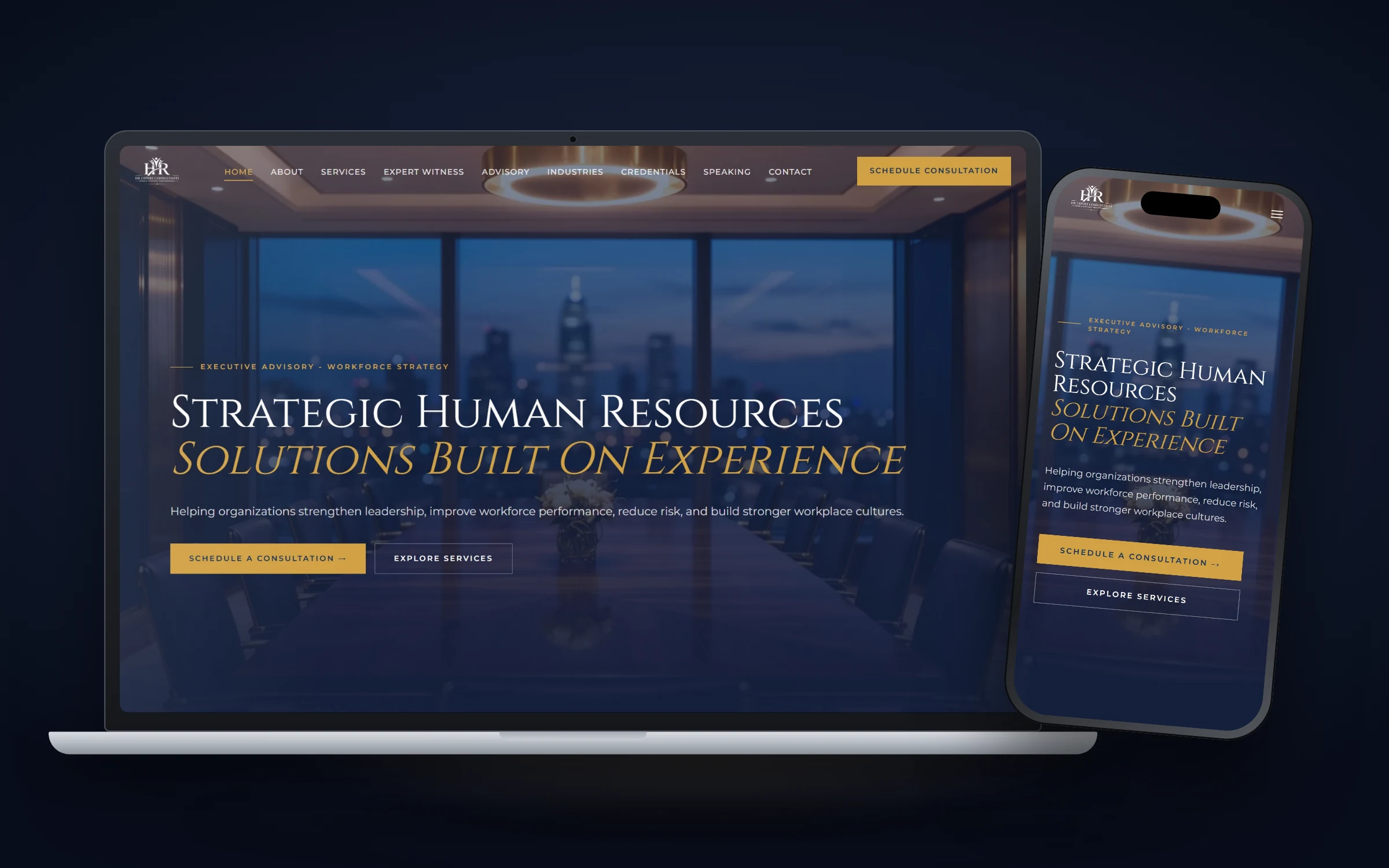
That second version is something we actually publish on our HR Expert Consultants case study, where the typical timeline shown is four weeks. It answers the question, gives a number, names what changes it and stands on its own. If ChatGPT lifted only that passage, it would still make sense.
A few writing rules we follow on every page we build:
- Name the subject in the answer. Write “A security vulnerability assessment usually…” rather than “It usually…” Passages get pulled out of context, so pronouns that point back up the page break.
- Match the format to the question. See the table below.
- Skip the warm up. No “Great question!” and no history lesson before the answer.
- Date things that change. Fees, regulations and standards go stale. “As of 2026” tells a reader and a machine how fresh the answer is.
| Question type | Best answer format | Example question |
|---|---|---|
| What is | One or two sentence definition, then detail | What is a threat assessment team? |
| How to | Numbered steps | How do we prepare for a security audit? |
| Which or versus | A short verdict, then a table | Expert witness or consulting expert? |
| How much or how long | A range, then what moves it | How long does an HR investigation take? |
| Who should | Named criteria or a checklist | Who should run our active shooter training? |
Our website copywriting tips go deeper on writing for busy readers. The good news is that the same habits work for humans skimming on a phone.
What about FAQ sections and schema?
FAQ sections are useful for AEO because they’re literally questions with direct answers. But be realistic about the markup. Google cut back FAQ rich results in August 2023 so they show mainly for well known government and health sites (Google Search Central blog), and it says no special schema is needed for its AI features.
We still add FAQPage, Person and ProfessionalService schema on consultant sites anyway. It states your name, role and services in a format no machine can misread, and plenty of tools besides Google read it. Our guide to schema markup for small business shows which types to use and how to add them on WordPress.
Entity consistency: the part most consultants skip
An answer engine recommending a consultant is making a bet. It’s more willing to make that bet when every source tells the same story about you.
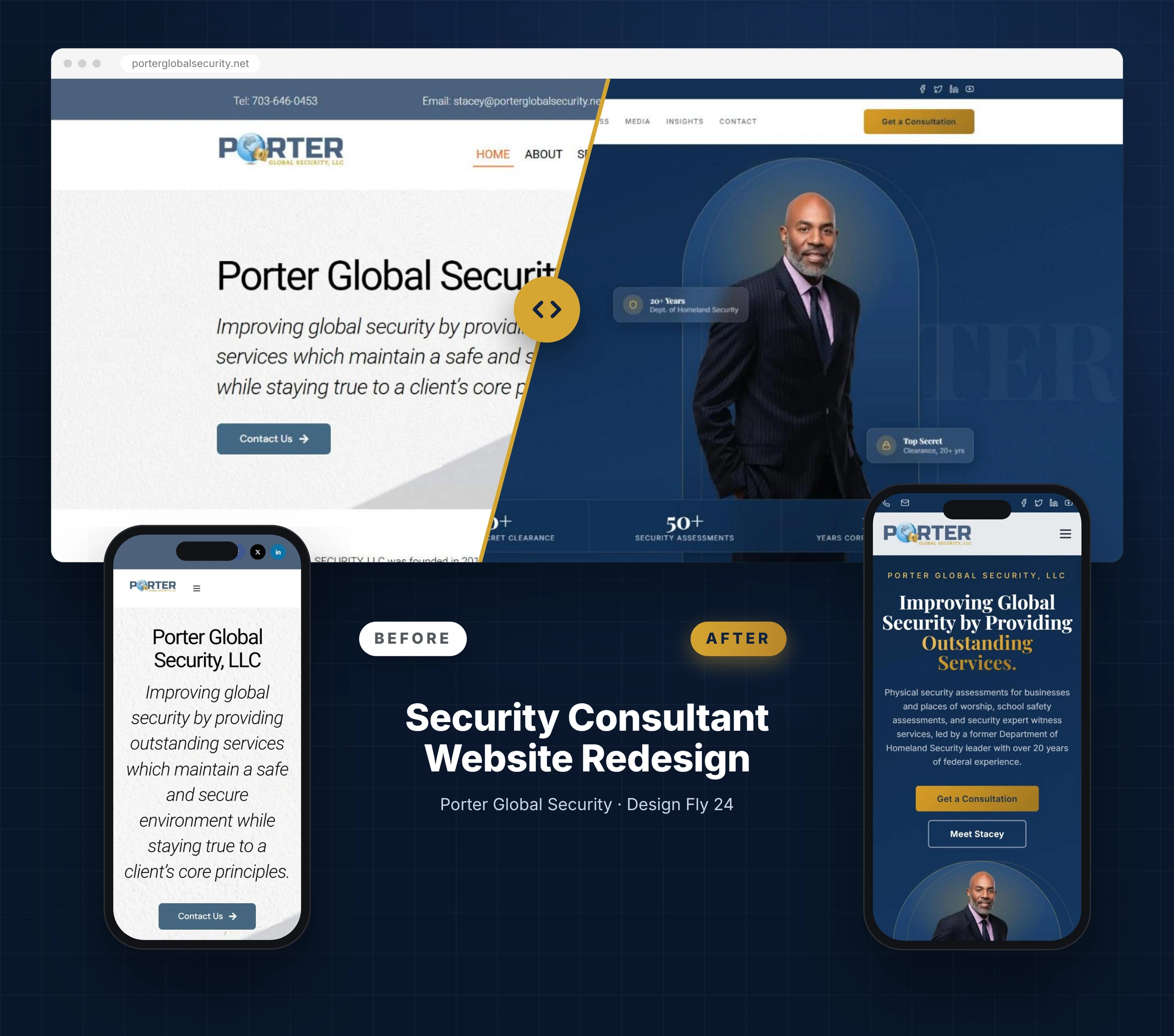
When we rebuilt the site for Porter Global Security, a lot of the work was about clarity for exactly this reason. Stacey D. Porter’s services are spelled out as four specific areas, there’s a dedicated Expert Witness page for attorneys, and her professional affiliations (IAPSC and InfraGard among them) sit right under the hero. A human scanning the page knows in seconds who she is. So does a machine.
Do a quick audit of your own. Search your name and firm name, open every profile on the first two pages and compare: name, title, one line description, location, website link. Fix your LinkedIn first (our LinkedIn profile optimization service exists largely because this is where consultants drift most). Then your Google Business Profile, then directories and association listings.
It’s dull work. It’s also some of the highest return AEO work there is.
How to get recommended by AI: reviews and third party mentions
You can’t write your way into every AI answer from your own site alone. When someone asks “who are the best workplace violence prevention consultants,” the engine looks for outside confirmation: reviews, articles that quote you, conference speaker pages, podcast show notes, association directories.
For consultants, that rarely means chasing national press. A quote in your trade association’s magazine or a speaker bio that matches your website word for word does more than you’d think.
Reviews count too, especially on Google if you have a Business Profile. Ask happy clients for a short review that mentions the specific work you did. We cover a low pressure way to do that in how to get Google reviews from busy professionals. Never buy or write them yourself.
How to measure answer engine optimization
Measurement is the weakest part of AEO, and I’d rather say that plainly. A lot of the value happens without a click: someone reads your name in an answer, then searches for you directly a week later. Still, there are three things worth tracking.
1. Google Search Console. AI Overviews and AI Mode traffic is counted in the normal Performance report under the “Web” search type (Google Search Central). In June 2026 Google also started rolling out a Search generative AI performance report to a subset of sites. At launch it shows impressions by page, country, device and date, but not clicks or queries. If your property has it, check which pages appear in AI features. If not, filter the main report with a custom regex such as ^(who|what|how|why|when|which|should|can|does)\b and watch whether impressions on question searches grow after you publish answer led pages.
2. GA4 referrals from AI tools. OpenAI says ChatGPT adds utm_source=chatgpt.com to referral links (OpenAI publishers FAQ). In GA4, build an exploration or a custom channel group where session source matches something like chatgpt|perplexity|gemini|copilot|claude. Then look at which pages those visitors land on and whether they contact you. If you’re new to GA4, start with our GA4 guide for small business.
3. A monthly prompt log. Pick ten questions a real buyer would ask, run them in ChatGPT, Perplexity, Gemini and Google once a month, and note whether you’re named or cited. It’s manual and a bit tedious. It’s also the only way to see the answer your prospect sees. Add a “How did you hear about us?” field to your contact form while you’re at it, because people will happily tell you “ChatGPT recommended you.”
Frequently asked questions
What is AEO in SEO?
AEO stands for answer engine optimization. Within SEO, it is the part focused on getting a passage of your content used as the answer in AI Overviews, AI Mode, ChatGPT, Perplexity and similar tools, rather than only ranking the page as a link.
Is answer engine optimization different from SEO?
It builds on SEO rather than replacing it. Google says its AI features have no extra requirements beyond normal SEO best practices. The difference is focus: AEO puts more weight on direct, self contained answers and consistent facts about who you are.
How do I get recommended by AI tools like ChatGPT?
Make sure AI search crawlers can reach your site, answer the questions buyers ask in plain language near the top of each section, keep your name and services identical across your site and profiles, and earn reviews and mentions on other reputable sites. No one can guarantee a recommendation.
What is LLM SEO?
LLM SEO is another label for optimizing content so large language model tools like ChatGPT, Gemini and Claude can find, understand and cite it. In practice it overlaps almost completely with answer engine optimization and generative engine optimization.
Does schema markup help with AEO?
Google says no special schema is required to appear in its AI features. Accurate Person, ProfessionalService and FAQPage markup still helps machines understand who you are and what a page covers, so we treat it as useful support, not a shortcut.
Do I need an llms.txt file?
Not for Google. Google says you do not need new machine readable files or AI text files to appear in AI Overviews or AI Mode. It does no harm to add one, but we would spend that time on better answers and cleaner profiles first.
How long does AEO take to work?
Answer engines that search the live web can use a new page once it is indexed, sometimes within days. Being recommended by name depends on reputation signals that build over months. Our post on how long SEO takes explains the timelines in more detail.
Where to start with answer engine optimization
Want the bigger picture on how AEO fits with SEO and the newer term GEO? Read our guide to generative engine optimization and how it differs from SEO and AEO.
If you do one thing this week, take your most important service page and rewrite the top of each section so the answer comes first. Then write down the ten questions prospects asked you most this year and check whether your site answers each one clearly. Most consultant sites answer two or three. That gap is your AEO plan for the next quarter.
If you’d rather have someone do it with you, our SEO services cover AEO and GEO alongside classic search, from rewriting key pages to setting up the measurement above. Get in touch and we’ll look at how answer engines see your firm today and tell you honestly what to fix first.