
Quick answer: A DIFC consultancy website has to look credible to institutional buyers in the first screen: who you advise, who regulates you, and who the senior people are. Show your regulatory status and DFSA reference number where they apply, publish a privacy notice written for the DIFC Data Protection Law, add clear disclaimers, and make booking a meeting easy.
Search for “DIFC consultancy website” and you’ll mostly find company setup agents and register listings. Almost nobody writes about what the website itself should do once the license is issued. That’s odd, because for a boutique advisory or financial firm in the Dubai International Financial Centre, the website is often the first thing a family office, fund manager or general counsel checks after hearing your name.
We’re a New York web design agency, and we work remotely with firms in the Gulf (our mornings overlap with your afternoon, which makes calls easy). We won’t pretend to know your compliance obligations better than your compliance officer, but we do know how expert firms win trust online. This guide covers what a website for a DIFC company needs, from regulatory wording to the pages institutional buyers actually read.
Key takeaways
- Institutional buyers judge credibility fast. Regulatory status, people and track record belong above the fold.
- If you’re DFSA regulated, show your reference number and link to your entry on the DFSA Public Register. Clone sites make this matter.
- The DIFC Data Protection Law sets out what you must tell people when you collect their data. Your contact forms and newsletter signup need to follow it.
- Write disclaimers and regulatory wording with your compliance team, then design around them so they read as reassurance, not fine print.
Who visits a DIFC consultancy website, and what they check
Your visitors aren’t browsing. A typical DIFC advisory firm, law firm or wealth manager gets a small number of very high value visits: a referral checking you out before an intro call, a procurement team building a shortlist, a lawyer verifying who they’re about to instruct.
Each of them is asking roughly the same questions:
| Visitor | What they want to confirm | Where your site answers it |
|---|---|---|
| Family office or fund manager | Are you regulated for what you’re offering, and by whom? | Regulatory status line in the footer and on the About page, with a register link |
| Corporate client or procurement | Have you done this for organizations like ours? | Sector pages and anonymized engagement summaries |
| General counsel or referring lawyer | Who exactly will do the work? | Team pages with real bios, qualifications and photos |
Regulatory status: show it clearly and correctly
If your firm is authorised by the Dubai Financial Services Authority, your regulatory status is the single most important trust signal on the site. It also needs to be exactly right, so the wording should come from your compliance function and the DFSA rules that apply to your license, not from your web designer.
From a design and trust point of view, here’s what we recommend:
- A consistent status line in the footer of every page, including your legal entity name, that you’re regulated by the DFSA, and your reference number.
- A link from that line to your entry on the DFSA Public Register, so anyone can verify it in one click.
- A clear statement of who your services are for, if your license limits you to certain client types. Put it where people make decisions, not only in the legal pages.
- Official contact details only: your DIFC address, a UAE phone number and email on your own domain.
Why the fuss? Because fraudsters copy regulated firms. In one DFSA alert from June 2021, the regulator warned that a DIFC firm’s website had been cloned, with scammers “fraudulently using” its look, content and DFSA reference number, and contact numbers outside the UAE. The DFSA told consumers to check its Public Register of regulated firms and authorised individuals. A clean site that links to your own register entry and lists consistent official contact details makes it far easier for a client to tell you apart from an impersonator.
If you’re a DIFC registered firm that isn’t DFSA regulated (many consultancies aren’t), be careful not to imply otherwise. Words like “regulated” or a regulator’s logo where they don’t belong are the kind of thing institutional buyers notice and don’t forget.
The DIFC Data Protection Law and your website
The DIFC has its own data protection regime. Data Protection Law No. 5 of 2020 took effect on July 1, 2020, replacing the 2007 law. For a website, the parts that matter most are about what you tell people when you collect their details, and how you handle marketing.
Under Article 29 of the law, when you collect personal data directly you have to give people information at the time of collection, including your identity and contact details, the purposes and lawful basis for processing, who receives the data, any transfers outside the DIFC and the safeguards, how long you keep it, and their rights (including the right to complain to the Commissioner). Article 12 sets out what valid consent looks like: freely given, by a clear affirmative act, and as easy to withdraw as to give. Article 34 gives people the right to object to direct marketing at any time.
In practice that turns into a short list of website tasks:
- A privacy notice written for the DIFC law, linked from every form and the footer.
- A short notice next to each contact form saying what you’ll do with the details, with a link to the full notice.
- Newsletter signup with an unticked box and a separate purpose, never bundled into the contact form.
- An easy unsubscribe in every email, and a way to object to marketing that actually works.
- Cookie and analytics settings agreed with your advisers, especially if your tools send data outside the DIFC.
Pages every DIFC consultancy website needs
The structure is close to what we build for expert firms in New York, with a few additions for the regulatory side:
- Homepage: who you advise and on what, one line of regulatory status, leadership photos, and a single “Arrange a meeting” button.
- Services or capabilities: one page per service line, written for the buyer, not the license schedule.
- Sectors or clients served: family offices, corporates, funds, government related entities, whatever is true for you.
- People: a page for each partner or director with qualifications, prior firms and a real photo. This is the most visited page on most advisory sites.
- Insights: dated market notes and regulatory updates. They prove you’re active and give AI search tools something to cite.
- Regulatory information: status, register link, complaints procedure if your license requires one, and disclaimers.
- Privacy notice and terms.
- Contact: office address in the DIFC, map, phone, and a short form.
Our guide to consultant website design goes deeper on page by page structure, and the About page guide helps with the people section.
Looking credible to institutional buyers
Wealth management websites in Dubai tend to fall into two traps. Some go full luxury with gold gradients and skyline videos. Others look like a 2012 law firm site. Neither reassures a sophisticated buyer.
What works is restraint plus proof. A calm palette, generous white space, a serif for headings, real photos of your people, and specific evidence near the top.
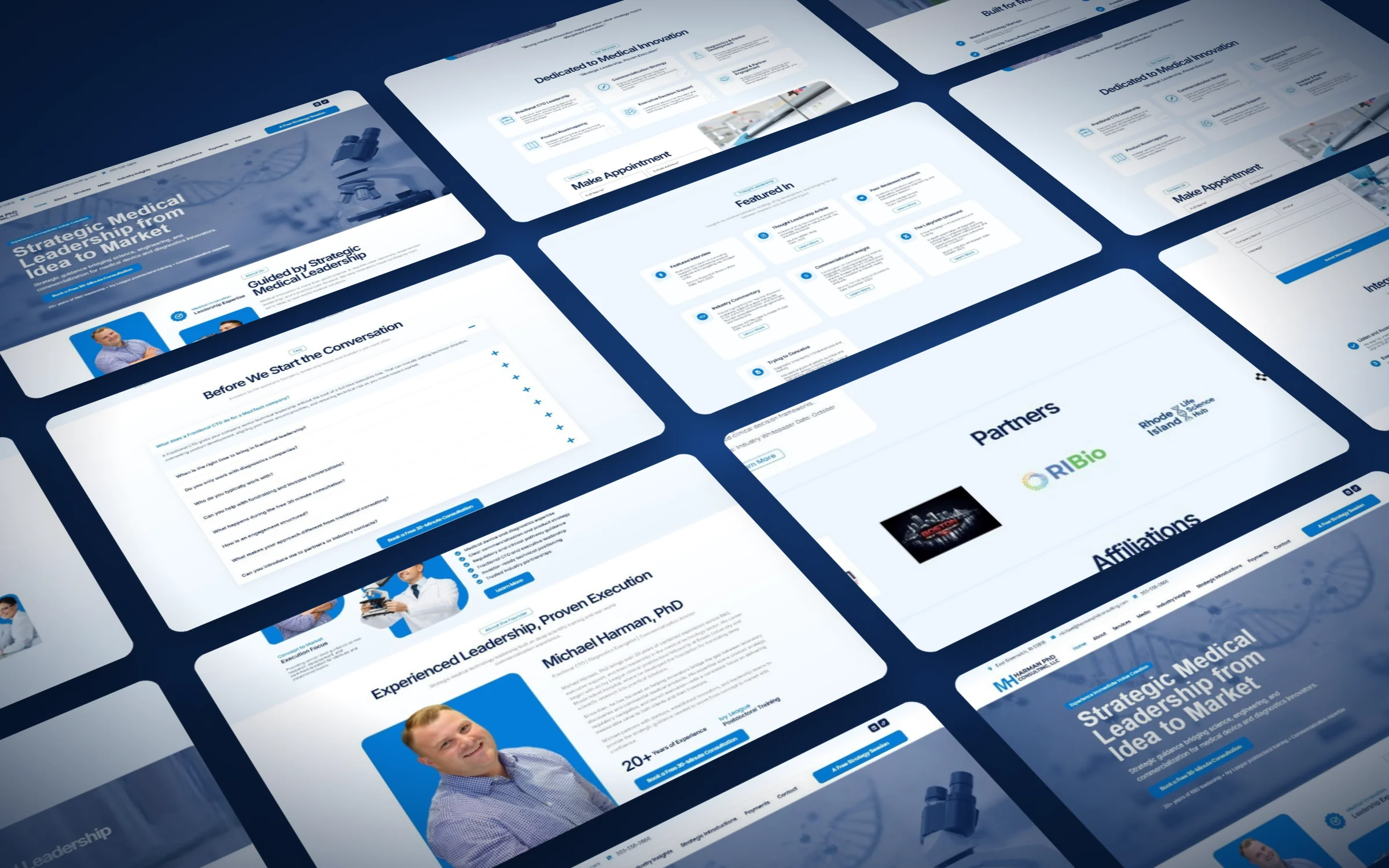
We did something similar for Harman PhD Consulting, a MedTech advisory firm whose clients include founders preparing funding rounds and investors who need an independent technical opinion. The site leads with Michael Harman’s background (more than 20 years in R&D and leadership, a clinical postdoc at Brown University and Rhode Island Hospital), carries a named testimonial from a director at GSK, and lists Featured In items with type, source and date. Deep navy and white, laboratory imagery, and a booking button in the header. Swap the lab photos for your own office and team and the same approach suits a DIFC advisory firm talking to investors.
English, Arabic or both?
For many DIFC firms whose buyers are international institutions, English is the working language of the site. If you also serve local families, government related entities or Arabic speaking principals, a proper Arabic version (right to left layout, not machine translated) is a strong signal of respect and seriousness. Decide based on who signs your engagement letters, not on what competitors do.
If you add Arabic, plan it from the start with separate URLs per language and a translator who knows financial terminology.
Building a DIFC firm website step by step
This is the order we’d follow for a new site or a redesign:
- 01
Agree the regulatory wording first
Get status lines, disclaimers and the privacy notice from compliance before design starts, so the layout is built around them.
- 02
Define the buyer and the first screen
Write one line saying who you advise on what, and choose the proof that sits directly beneath it.
- 03
Write the people pages
Real bios, qualifications, prior firms and professional photos for every senior person.
- 04
Design a homepage concept
Review one page in full before building the rest, so tone and trust signals are right.
- 05
Build forms with notices
Every form gets a short data notice, a link to the full privacy notice and separate marketing consent.
- 06
Add verification links
Link your status line to the DFSA Public Register entry and check every contact detail is official.
- 07
Launch, then publish insights
A dated market note or regulatory update each month keeps the site current and searchable.
Frequently asked questions
What should a DFSA regulated firm website include?
A clear regulatory status line with your legal name and DFSA reference number, a link to your Public Register entry, official contact details, disclaimers approved by compliance, and a privacy notice written for the DIFC Data Protection Law.
Does a DIFC company need a privacy notice on its website?
If the site collects personal data through forms, newsletters or analytics, yes. Article 29 of DIFC Data Protection Law No. 5 of 2020 lists the information you must give people at the time you collect their data.
Can a New York agency build a website for a DIFC company?
Yes. We work remotely with Gulf businesses, and our mornings overlap with your afternoon for calls. Your compliance and legal advisers approve regulatory wording; we handle design, build and SEO.
Should a DIFC law firm website be in Arabic?
It depends on your clients. Firms serving international institutions often work in English, while firms advising local families or government related entities benefit from a proper right to left Arabic version.
How much does a DIFC consultancy website cost?
It depends on the number of pages, languages and how much writing you need. We start with a free homepage concept so you can judge the direction before committing.
Credibility is the product
For a boutique DIFC firm, the website rarely wins the client on its own. It confirms what a referral said, or quietly undermines it. Getting regulatory status, people and proof right does more for you than any amount of skyline footage.
If you’d like a site built on that principle, see our website design services, or contact us to book a call and ask for a free homepage concept.