Quick answer: Good medical device website design gives each audience its own path (investors, clinicians, partners and future hires), keeps every product claim consistent with the device’s regulatory status, and proves credibility through the team, clinical evidence, IP and named partners. It should also load fast, work on a phone and meet accessibility basics.
A medical device company website gets read by people who are paid to be skeptical. An investor looking for the weak point in your story. A clinician wondering whether your evidence would hold up at journal club. A distribution partner checking whether you’ll still exist in two years. And, occasionally, a regulator.
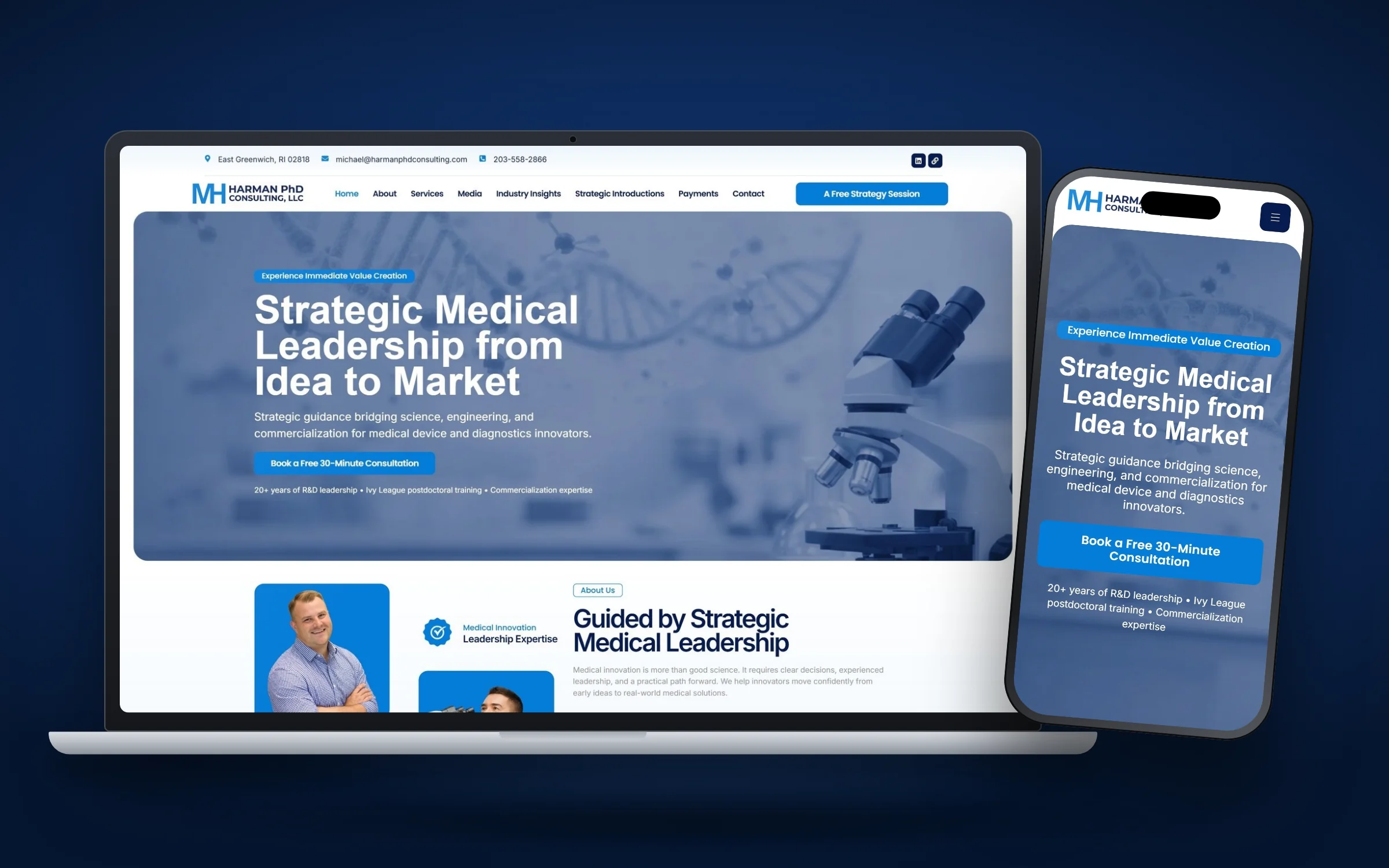
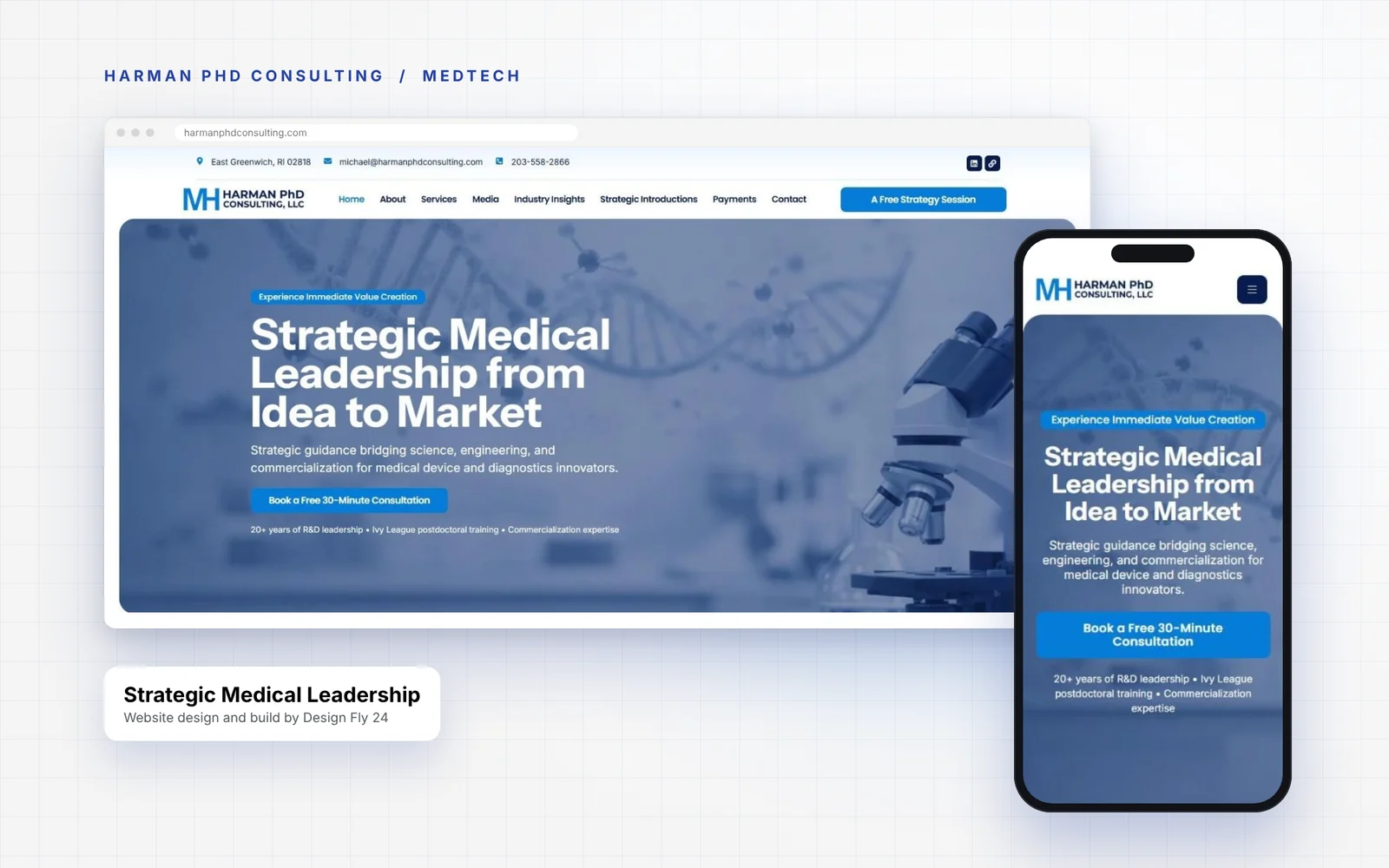
That makes medical device website design different from most B2B sites. Clever copy matters less than clarity and claim discipline. This guide covers what each audience checks, how to handle regulatory language, and the pages a MedTech startup website needs. We designed the site for Harman PhD Consulting, a MedTech advisory firm whose clients include device founders preparing for funding and regulatory milestones, and the lessons below come partly from that work.
One note before we start: we’re web designers, not regulatory counsel. Have your regulatory lead review every product claim before launch.
Key takeaways
- Investors, clinicians, partners and candidates read your site for different things. Give each a clear path from the homepage.
- Your website is promotional material. Claims must match your regulatory status, and “FDA cleared” is not the same as “FDA approved.”
- Credibility comes from named people, real evidence and specific partners, not adjectives.
- Keep the site easy to update, because your regulatory status, data and team will change.
Who reads a medical device company website (and what they check)
| Audience | What they look for | What loses them |
|---|---|---|
| Investors | The problem and market, regulatory pathway and stage, team, IP, milestones | Vague claims, no named leadership, no sense of stage |
| Clinicians | Clinical problem, how the device works, evidence and publications, indications | Marketing language where data should be, overstated outcomes |
| Partners and distributors | Regulatory status by market, quality system, manufacturing, contact for partnerships | No clear partnership path, outdated news |
| Candidates | Mission, team, culture, open roles | No careers page, no faces |
| Patients (if relevant) | Plain language explanation, availability, where to ask | Technical jargon, unclear availability |
The homepage can’t satisfy everyone in full, so its job is routing. A short statement of what the device does and for whom, then clear doors: “For clinicians,” “For investors,” “Partner with us.”
We used the same idea on the Harman PhD Consulting website. Michael Harman, PhD, has more than 20 years across MedTech R&D, executive support and team leadership, and his buyers are founders preparing for a funding round, teams approaching regulatory milestones and investors who want an independent technical opinion. The page includes a “Built for Medical Innovation Leaders” section that speaks to startups, scaling teams and investors separately, so each one sees themselves within a scroll.
Regulatory claim discipline on medical device websites
This is the section that separates good medical device website design from attractive but risky sites. Your website counts as promotion of your device, so the claims on it need the same discipline as a sales deck or brochure.
Investigational devices. If your device is still in clinical investigation in the US, 21 CFR 812.7 prohibits sponsors and investigators from promoting or test marketing it before FDA approval, and from representing that it is “safe or effective for the purposes for which it is being investigated.” In practice, that usually means describing the problem you’re working on, the technology and the study, with clear “investigational device” language, and avoiding efficacy claims.
Cleared vs approved. A 510(k) clearance is not an approval. 21 CFR 807.97 says a substantial equivalence determination “does not in any way denote official approval of the device,” and that implying official approval on that basis “is misleading and constitutes misbranding.” If your device is cleared, say “FDA cleared,” and say it accurately.
Indications. Describe the device for its cleared or approved intended use. Case studies, testimonials and blog posts count too; a glowing story about an off label use is still a claim on your site.
Other markets. If you’re CE marked or approved elsewhere but not in the US, make the status by market explicit so a US visitor isn’t misled.
A practical way to keep this under control: give your regulatory lead edit or approval rights on product pages, keep a simple claims log, and date your news and data pages so outdated status statements are easy to spot.
Pages every medical device startup website needs
A focused MedTech startup website doesn’t need dozens of pages. It needs the right ones, built in roughly this order:
- 01
Homepage
What the device does, for whom, current stage in one line, and doors for each audience. One clear primary action, such as "Contact us" or "Request a meeting."
- 02
Technology or product page
How it works in plain language, with diagrams. Status by market stated clearly. Claims reviewed by regulatory.
- 03
Clinical evidence page
Studies, publications and presentations with full citations and dates. Let the data speak; avoid summarizing it more positively than the paper does.
- 04
Team and advisors
Named people with photos, short bios and relevant credentials. This is where investors and clinicians decide whether to trust you.
- 05
News and media
Dated milestones, funding announcements, conference appearances and press coverage.
- 06
Partners and investors
Who you work with, with permission, plus a clear path for partnership inquiries.
- 07
Careers and contact
Open roles, culture in a few honest lines, and contact routes by audience.
Credibility signals that work in MedTech
Adjectives don’t build trust with this audience. Specifics do.
Named people. Founders, clinical advisors and board members with real photos and relevant credentials. On the Harman site, the founder section and an academic affiliations strip (including Brown University and UConn) carry more weight than any tagline.
Named partners and testimonials. With permission. The Harman homepage features a testimonial carousel naming GSK, Exact Sciences and Alnylam Pharmaceuticals, including a quote from a GSK director: “Michael is a valuable partner. I would gladly work with him again.” One attributed quote from a recognizable organization beats a page of anonymous praise.
Evidence with dates and sources. Publications, conference posters and interviews, each with the source and date. The Harman site has a “Featured In” section built exactly that way.
IP, stated carefully. “Patent pending” or granted patent numbers, where your counsel is comfortable sharing them.
Process. A short “how we work” or “development roadmap” section helps investors see where you are. Harman’s site uses four steps (Listen and Assess, Define the Path Forward, Execute with Focus, Scale and Support).
Medical device website design: the technical side
- Mobile first. Investors and clinicians often open your link from an email on their phone. The Harman build used a compact sticky header, full width buttons and lightweight images for exactly this reason.
- Speed. Compress product renders and videos; a heavy hero video can make a technical audience bounce before the page loads.
- Accessibility. Readable contrast, alt text, keyboard navigation and captions on videos. Our website accessibility checklist covers the essentials.
- Security and forms. Keep contact forms simple and don’t collect health information through a website form unless you have the right safeguards. See our website security checklist.
- Easy updates. Your status, data and team will change. Build on a platform your team can update without a developer, with reusable sections for news, publications and team members.
Medical device startup marketing: where the website fits
For an early stage device company, the website rarely generates leads by itself. Its job is to make every other conversation easier: the investor meeting, the KOL introduction, the conference follow up, the partnership email. When someone you met at a conference looks you up that night, the site should confirm everything you said and make it easy to take the next step.
That means the copy should match your pitch deck in substance, your team page should match your LinkedIn profiles, and your news page should show momentum. For the writing side, our website copywriting tips apply directly.
Frequently asked questions
Can a medical device startup have a website before FDA clearance?
Yes. Describe the problem, the technology and your development stage, mark the device as investigational where it applies, and avoid safety or effectiveness claims. Have regulatory counsel review the copy.
What is the difference between "FDA cleared" and "FDA approved" on a website?
Clearance comes through the 510(k) pathway and approval through premarket approval. Federal rules say a 510(k) determination does not denote official approval, so use the term that matches your actual status.
What pages does a medical device company website need?
At minimum: homepage, technology or product, clinical evidence, team, news, partners and contact. Add careers and patient information if they apply.
How do we write for clinicians and investors on the same site?
Give each audience a separate page or section, linked from the homepage. Clinicians want mechanism and evidence; investors want market, stage, team and milestones.
Which platform is best for a medtech startup website?
One your team can update quickly. WordPress, Webflow and similar platforms all work. What matters more is a clean structure and an approval process for claims.
How long does a medical device website take to build?
A focused startup site typically takes a few weeks of design and build, plus time for content and regulatory review, which is often the longest step.
Build for the skeptic
The best medical device website design assumes every reader is smart, busy and skeptical, because they usually are. Route each audience quickly, keep claims within your regulatory status, and let named people and dated evidence do the persuading.
If you’re planning a new site or fixing one that undersells your science, see our website design for MedTech page or contact us for a free homepage concept before you commit.