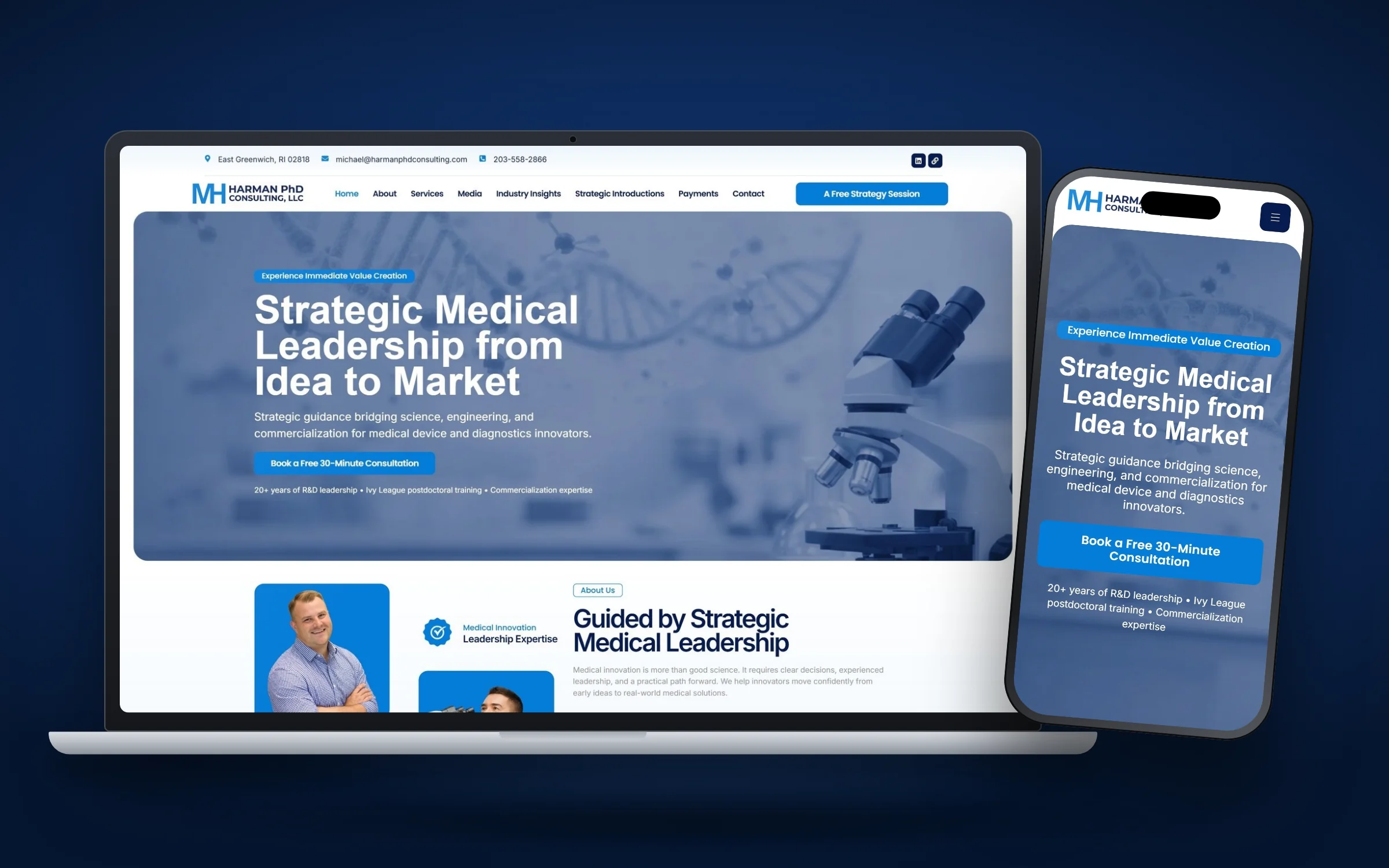
Quick answer: Yes, AI website builders are good at producing a decent looking first draft in minutes, and fine for a simple placeholder site. They are weak at the things that win clients: a clear message for a specific buyer, real proof, solid SEO setup and edits that don’t break the layout. Use AI for speed, a designer for judgment.
Are AI website builders good? I get the question every week now, usually from a consultant who just typed a prompt into Wix, Framer or Lovable and watched a full homepage appear in under a minute. It looks finished. So why pay a person?
I’ll be upfront: I build with Lovable myself. It’s in my daily toolkit for quick concepts, and some of what it produces is genuinely impressive. That’s exactly why I can tell you where it falls short for a business site, because I’m the one cleaning up after it.
Key takeaways
- AI builders are good at speed and first drafts. They are not good at knowing your buyer, your proof or your positioning.
- The real cost of an AI site shows up later: generic copy, thin SEO setup and edits that are harder than they looked.
- Check code ownership and hosting before you commit. Some tools let you export and host anywhere, others keep you on their platform.
- For most small firms, the best answer is AI for drafts plus a human for strategy, copy and the build that ships.
What AI website builders are good at
Let’s give them their due. A modern AI builder will take a sentence about your business and return a layout, color palette, stock imagery and passable placeholder copy. For a few things, that’s all you need:
- Testing an idea. A side project, an event page, a product you’re not sure anyone wants yet.
- A placeholder while you get your act together. Something better than a blank domain while the real site is planned.
- Getting unstuck. Seeing three directions on screen beats staring at a blank page. I use Lovable this way to rough out layouts before refining them.
- Internal tools. A booking calculator or an intake form app, where looks matter less than function.
One honest caveat on speed. Owain Williams at TechRadar Pro argued in 2025 that “build a site in under a minute” mostly replaces picking a template, not designing from scratch, so the time saved is smaller than the marketing suggests. In his piece, Hostinger shared that AI built sites got a 60% satisfaction score from its users. That’s fine. It isn’t a ringing endorsement.
Are AI website builders good for a business site? Where they break
Here’s what I see when someone sends me their AI built site and asks why it isn’t bringing in calls.
The copy could belong to anyone
The AI writes “We deliver tailored solutions to help your business thrive.” So does every other AI site. It can’t know that your best clients are school districts that need a written assessment before budget season, or attorneys who need an expert witness with a clean deposition record. That specificity is what makes a visitor think “this person gets my problem,” and it comes from a conversation, not a prompt. Our website copywriting tips go deeper on this.
Proof gets invented or left out
AI fills gaps. I’ve seen generated pages with testimonial blocks from people who don’t exist and stat counters with made up numbers. Publish that by accident and you’ve got a trust problem far worse than a plain site. Real credentials, real client logos and real case studies have to come from you.
Edits get messy
The first draft is easy. Change number twelve is where it hurts. Ask the AI to move one section and it sometimes rewrites three others. Joshua Hawkins at BGR put it bluntly after testing: sorting through the AI’s choices can take longer than building the page by hand. That matched my experience on fiddly layout changes.
SEO is a checklist, not a strategy
Most builders now generate titles, meta descriptions and a sitemap. Lovable, to its credit, has an SEO review that checks metadata, indexing, structured data and robots.txt. But no tool decides which services deserve their own page, which keywords a buyer in your niche actually types, or how your pages link together. That’s the work that moves rankings.
AI website builder vs web designer: side by side
Here is how the two compare on the things a consultant or small firm actually cares about.
| AI website builder | Web designer | |
|---|---|---|
| Time to first draft | Minutes | Days to a week |
| Message and positioning | Generic unless you supply it | Built from a discovery call about your buyers |
| Proof and trust signals | Placeholders, sometimes invented | Your real credentials, cases and reviews |
| SEO | Basic tags and sitemap | Page plan, keyword mapping, internal links, schema |
| Making changes later | Easy for small things, unpredictable for layout | Predictable, especially with a reusable component system |
| Ownership and hosting | Depends on the tool | You own the site and choose the host |
| Upfront cost | Low | Higher, depends on scope |
Ownership: the question nobody asks until it's too late
Before you build anything, find out what you’d own if you left. Tools differ a lot here.
Lovable is fairly open. Its FAQ says the code and content you create are yours, paid plans can download the full codebase, any plan can sync to a Git repository, and you can host the app elsewhere. It also says apps created since May 2026 render pages on the server, while older projects render in the browser and rely on prerendered copies for search engines and AI crawlers. That detail matters for AI generated website SEO: if you’re on an older project, check how Google actually sees your pages.
Wix and Squarespace sit at the other end. Your design lives on their platform, and leaving means rebuilding. That’s fine if you never plan to leave. Just make the choice on purpose.
So, are AI website builders good for your business?
My honest take, by situation:
- Brand new side project, tiny budget: Use an AI builder. Ship it, learn, upgrade later.
- Solo consultant whose clients find you through referrals: An AI draft can work if you rewrite every word yourself and add real proof. Most people don’t, and it shows.
- Firm selling to districts, corporations, law firms or hospitals: Hire a designer. Those buyers check your site before they call, and a generic page costs you the shortlist.
- You need custom features or integrations: Look at custom website development, possibly with AI helping on the build.
The hybrid is where things are heading, and it’s how I work. I’ll use AI to explore layouts quickly, then the real work happens in a discovery call, in writing copy that sounds like the client, and in building on WordPress or another platform the client controls. AI saves me hours on the parts that don’t need judgment. It can’t replace the parts that do.
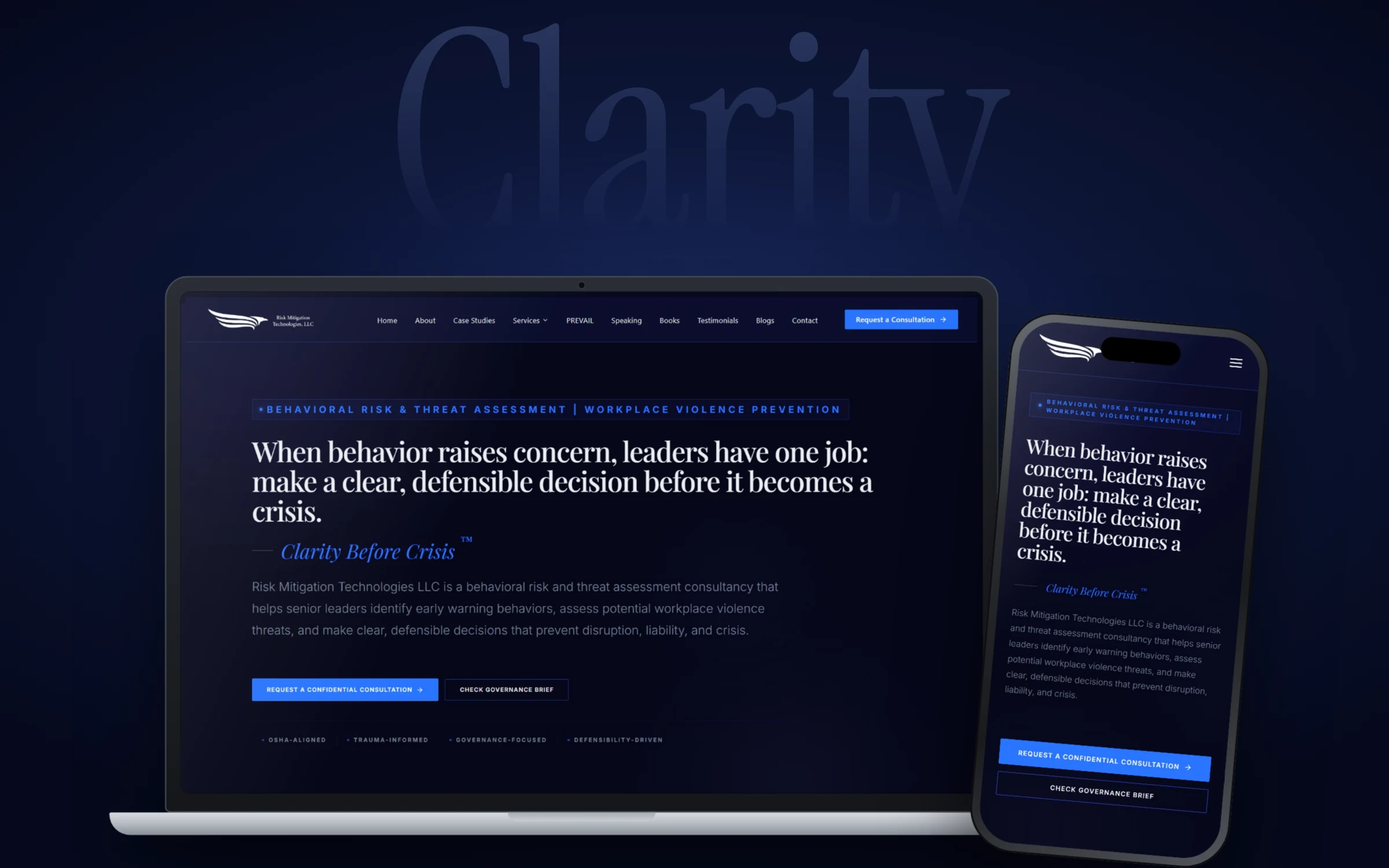
A good example of the difference is the Risk Mitigation Technologies site. The old site had diluted messaging and no single next step. The fix wasn’t a prettier layout. It was a clear primary call to action, “Request a Confidential Consultation,” placed in the header, hero and key sections, plus real founder photography instead of stock. An AI builder would have given them a cleaner template and the same muddled message.
Frequently asked questions
Is an AI website builder good for a small business?
For a simple placeholder or a test project, yes. For a site that has to win clients against competitors, it usually needs a human to write the message, add real proof and plan the SEO.
Are AI generated websites bad for SEO?
Not automatically. The risk is thin, generic copy and, on some tools, pages that render in the browser. Check that Google can read your pages and that each service has a real, specific page.
Can I start with AI and hire a designer later?
Yes, and many people do. Check first that you can export your content and code, so the designer can reuse what is good instead of starting from zero.
Do web designers use AI now?
Many do, for drafts, layout exploration and code help. I use Lovable for early concepts. The judgment about message, structure and proof still comes from the designer.
What is the biggest risk of an AI built site?
Publishing invented testimonials, statistics or claims by accident. Always replace placeholder proof with real credentials and real client feedback before launch.
How do I pick a web designer instead?
Look at real case studies in your industry, ask who does the work, and ask what you will own after launch. Our guide on choosing an agency lists the questions.
The bottom line on AI website builders
AI website builders are good tools in the right hands. They’re bad replacements for knowing your buyer. If your site is a business card, use one. If it’s the place where a district, an attorney or a hospital decides whether to call you, the thinking behind it matters more than how fast it was generated.
If you want both, our website design services start with a free homepage concept so you can see the difference before you pay anything. Read our guide on how to choose a web design agency, then get in touch.