Quick answer: Expert witness directories can be worth it for experts in specialties attorneys search for often, as long as the listing is complete and you track whether it produces cases. They work best as one channel feeding your own website, LinkedIn profile and attorney referrals, not as your only source of work.
Every expert who starts taking litigation work gets the same pitch within a few months: list in our expert witness directory and attorneys will find you. Some do. Many experts also pay for a listing year after year without ever checking whether a single case came from it.
This is a neutral look at how expert witness directories and referral services work, when they pay off, and what to build alongside them so you aren’t renting all of your visibility. We design websites and LinkedIn profiles for consultants who testify, so we see the other half of the picture: what an attorney finds after the directory click.
Key takeaways
- Directories, referral services and association rosters run on different business models. Know who pays and who controls the client relationship before you sign up.
- A directory listing nearly always ends with the attorney checking your website and LinkedIn. If those are weak, the listing underperforms.
- Track the source of every inquiry for 12 months before renewing any paid listing.
- Your own expert witness page is the one channel you fully control and keep.
What expert witness directories actually are
The term covers several different kinds of service, and lumping them together is how experts end up disappointed.
| Type | How it usually works | Who controls the relationship |
|---|---|---|
| Paid listing directories | You pay for a profile; attorneys search by subject and contact you directly | You |
| Referral and matching services | The service screens cases and matches attorneys with experts; terms vary on who pays and how fees are handled | Often shared with the service |
| Association and bar rosters | Lists run by professional bodies or legal organizations, sometimes free to members | You |
| General legal directories | Broad legal resource sites with an expert section | You |
SEAK, for example, describes its expert witness database as free for attorneys to search, with attorneys contacting experts “directly, with no middleman,” and profiles that can include a CV, photo and articles. Other services, such as JurisPro, ExpertPages and HG.org’s expert section, follow listing models of their own. Matching services work differently again. Expert Institute, which runs one, argues in its own article on how directories fall short that listing fees, payment handling and limited promotion are weaknesses of the directory model. Keep in mind each company is describing its own model favorably.
Before signing anything, read the terms for four things: the annual cost, whether the service takes a share of fees, whether it ever collects payment from the attorney on your behalf, and whether you can leave without losing anything.
Are expert witness directories worth it?
Sometimes. In our experience the answer depends less on which directory you choose than on the points below.
Your specialty. If attorneys regularly need experts in your field (accident reconstruction, medical specialties, premises security), directory searches happen often and a good profile can be found. If your niche is rare, attorneys are more likely to ask colleagues or search Google by name.
Your profile. A listing with a one line bio and no CV competes poorly against a full profile with specific case types, a recent photo and articles. Fill every field.
What happens after the click. This is the part people forget. An attorney who finds you in a directory will almost always look you up before calling. The UK Expert Witness Institute notes in its marketing guidance announcement that “solicitors do not use directories as their primary method for finding experts.” Directories put your name on a shortlist. Your website and LinkedIn decide whether you stay on it.
How to choose between expert witness listing services
If you decide to list, run each option through the same short process. It takes an hour and saves you from renewing a listing that does nothing.
- 01
Search it like an attorney would
Search the directory for your own specialty and state. Count how many experts appear and how complete their profiles are. If you would be one of 200, think twice.
- 02
Check whether it ranks
Google your specialty plus "expert witness." If the directory's category pages show up, it brings its own traffic. If not, attorneys must already know it.
- 03
Read the terms
Look for the annual cost, any share of fees, payment handling, exclusivity and cancellation terms.
- 04
Build a complete profile
Use the same specialty wording, credentials and photo as your website and LinkedIn, and link to your own expert witness page.
- 05
Track every inquiry
Ask every attorney how they found you and record it. Renew only the listings that produce real engagements within a year.
What to build alongside expert witness directories
Think of directories as a way to be found by attorneys who don’t know you yet. Everything else you build is about being trusted once they do.
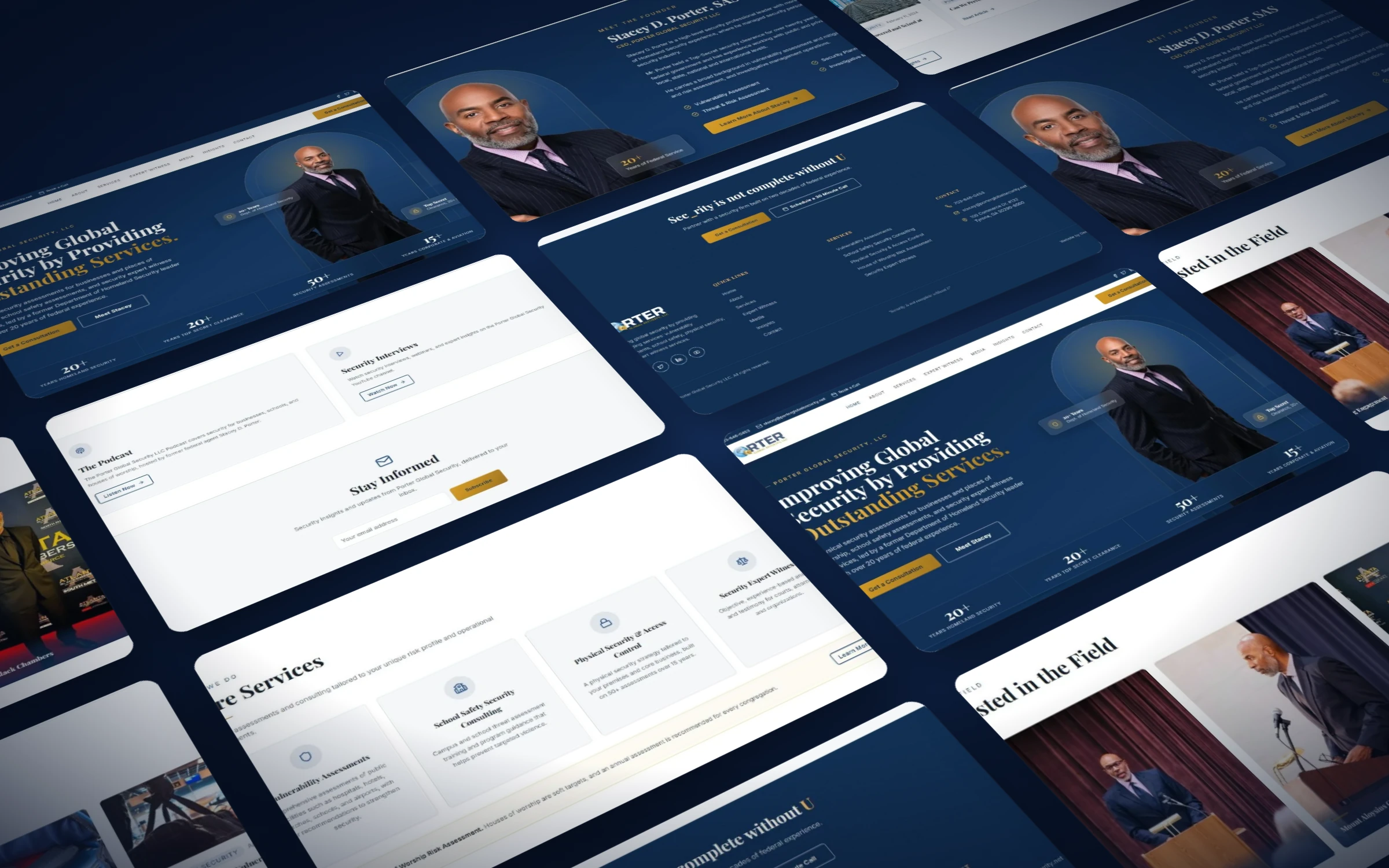
Your own expert witness page. A dedicated page on your website, written for attorneys, with practice areas, a summary of testimony experience, a downloadable CV and a confidential contact path. When we redesigned the site for Porter Global Security, Stacey D. Porter’s firm, we added an Expert Witness page aimed at attorneys and an “Expert Witness” item in the main menu, so a lawyer arriving from any directory or search lands on the right page in one click. Our expert witness website guide covers the layout.
A consistent LinkedIn profile. Attorneys check LinkedIn right after your website. For Secured and Prepared Consulting, a workplace violence prevention firm, the banner we designed names all four roles (“Expert Witness, Consultant, Speaker and Author”) and shows an As Seen On strip of national news outlets. See the expert witness LinkedIn branding case study.
Search visibility you own. Articles on your site that answer questions attorneys research help you rank for your niche, not just your name. Our SEO services focus on exactly this kind of narrow, high intent search for experts and consultants.
Referrals. The attorney who retained you last year is still your best source of the next case. Thank them, stay in touch, deliver well.

Directories vs owning your presence: a side by side view
| Directory listing | Your own website | |
|---|---|---|
| Speed to visibility | Immediate, inside the directory | Slower; search rankings build over months |
| Competition on the page | Listed next to other experts in your field | Only you |
| Depth | Limited fields and format | As much proof and detail as you want |
| Ownership | Disappears when you stop paying | Yours permanently |
| Best for | Attorneys who don’t know you yet | Attorneys who heard your name and are checking you out |
The two aren’t rivals. The strongest setup is a few well chosen listings that link to a strong expert witness page on your own site. Our website design for expert witnesses service is built around that page.
Frequently asked questions
What are the best expert witness directories?
The best one is the one attorneys in your specialty actually search. Search each directory for your own field and state, check whether it ranks on Google, and track results before renewing.
Do expert witness directories charge attorneys or experts?
It varies. Many listing directories charge experts an annual fee and are free for attorneys to search. Referral and matching services use different models. Read the terms to see who pays and whether the service takes a share.
Should I list in more than one directory?
Two or three well kept listings usually beat ten neglected ones. Every listing needs to match your CV and website exactly, which gets harder the more you have.
Is an expert witness referral service better than a directory?
Not automatically. A referral service may screen cases and save you time but can involve fee sharing or less direct contact with the attorney. Compare the terms side by side.
Do I still need a website if I am in a directory?
Yes. Attorneys usually look you up after finding you in a directory, and a dedicated expert witness page with your CV is what they expect to find.
How do I know if a directory listing is working?
Ask every new attorney how they found you and keep a simple log. If a paid listing has produced no engagements in 12 months, it is not working for you.
Rent a little, own the rest
Expert witness directories are a reasonable way to get in front of attorneys who don’t know you yet. Just don’t let them be the whole plan. Track what they produce, keep every profile consistent, and point them at a page you own.
If your website is the weak link in that chain, see our website design for expert witnesses or contact us for a free homepage concept.